Hey there! As a supplier of Open Arc Welding Wire, I've been in the welding game for quite a while. And one question that often pops up is: What is the impact of welding speed on the penetration of open arc welding wire? Well, let's dive right in and explore this topic.

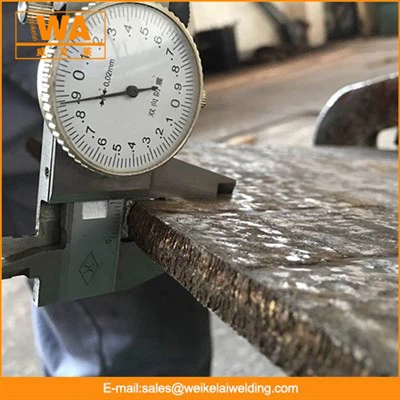
First off, let's understand what penetration means in welding. Penetration is how deep the weld metal goes into the base metal. It's super important because it affects the strength and quality of the weld. A good penetration ensures that the weld joint is strong and can withstand the stresses it'll face in its real - world application.
Now, welding speed plays a huge role in determining this penetration. When you increase the welding speed, the heat input per unit length of the weld decreases. Think of it like this: if you're moving the welding torch really fast, the heat from the arc doesn't have as much time to soak into the base metal. As a result, the penetration depth tends to be shallower.
On the other hand, when you slow down the welding speed, the heat input per unit length goes up. The arc has more time to transfer heat to the base metal, which allows the weld metal to melt deeper into it. So, generally, a slower welding speed leads to greater penetration.
But it's not as simple as just saying slow speed = good penetration. There are other factors at play too. For example, the type of open arc welding wire you're using can have an impact. We offer a variety of welding wires like Dual Shield Welding Wire, Metal Cored Welding Wire, and Stainless Flux Cored Welding Wire. Each of these wires has its own characteristics that can interact with the welding speed and penetration.
Dual shield welding wires are known for their high deposition rates and good slag removal. When using these wires, if you increase the welding speed too much, you might not get proper fusion and the penetration could be inconsistent. The slag might not have enough time to form and protect the weld properly, leading to potential defects.
Metal cored welding wires are great for high - speed welding in some cases. They can provide a relatively good balance between welding speed and penetration. However, if you push the speed too far, the wire might not have enough time to fully melt and mix with the base metal, resulting in reduced penetration.
Stainless flux cored welding wires are often used in applications where corrosion resistance is crucial. These wires require a certain amount of heat input to ensure proper penetration and a good quality weld. If the welding speed is too high, the heat might not be sufficient, and you could end up with a weak weld that's more prone to corrosion.
Another factor that interacts with welding speed and penetration is the welding current. Higher welding currents generally increase the heat input. So, if you're using a high current and a high welding speed, you might still be able to achieve a decent penetration. But if you're not careful, you could also end up with other problems like excessive spatter or a distorted weld bead.
Let's talk about some real - world scenarios. In a manufacturing setting where they're producing a large number of welds, there's often a trade - off between speed and quality. They want to finish the job as quickly as possible, but they also need the welds to be strong. In such cases, finding the right welding speed is crucial.
For example, in the construction of steel structures, the welds need to be strong enough to support the weight of the building. If the welding speed is too high and the penetration is insufficient, the weld joints might fail under the load, which could have catastrophic consequences.
In the automotive industry, where precision and speed are both important, engineers have to carefully select the welding parameters. They use advanced welding techniques and high - quality welding wires to achieve the right balance between welding speed and penetration.
Now, how do you determine the optimal welding speed for a particular job? Well, it's a bit of a trial - and - error process. You need to consider the type of base metal, the thickness of the base metal, the type of welding wire, and the welding current. You can start with some recommended settings from the wire manufacturer and then make adjustments based on the results of test welds.
It's also a good idea to keep an eye on the appearance of the weld bead. A good weld bead should have a smooth surface, consistent width, and proper fusion with the base metal. If the bead looks irregular or there are signs of lack of fusion, it could be a sign that the welding speed is off.
In conclusion, the impact of welding speed on the penetration of open arc welding wire is complex. It's not just about going slow or fast. You need to take into account the type of wire, the welding current, and the specific requirements of the job.
If you're in the market for high - quality open arc welding wires and need some advice on finding the right balance between welding speed and penetration, we're here to help. Whether you're a small - scale welder or a large - scale manufacturing company, we can provide you with the best products and support. Reach out to us for more information and let's start a conversation about your welding needs.
References
- AWS Welding Handbook, American Welding Society
- Welding Metallurgy and Weldability of Stainless Steels, John C. Lippold and David J. Kotecki
- Modern Welding Technology, Richard L. Petzold