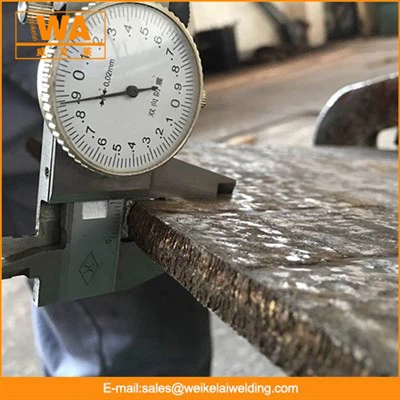
As a welding recondition supplier, I often encounter inquiries from clients about the feasibility of using welding recondition techniques for parts operating in corrosive environments. This is a crucial question, as the integrity and longevity of parts in such conditions are of utmost importance. In this blog, I will delve into the technical aspects, benefits, and limitations of using welding recondition for parts in corrosive settings.
Understanding Corrosive Environments
Corrosive environments can vary widely, from chemical processing plants where parts are exposed to strong acids and alkalis, to offshore oil rigs where saltwater corrosion is a constant threat. The corrosive agents can cause significant damage to parts over time, leading to reduced performance, increased maintenance costs, and even safety hazards.


The Basics of Welding Recondition
Welding recondition is a process that involves restoring damaged or worn parts to their original or near - original condition through welding. This can include filling in cracks, building up worn surfaces, and repairing damaged areas. The goal is to extend the service life of the parts and reduce the need for costly replacements.
Advantages of Welding Recondition in Corrosive Environments
- Cost - Effectiveness: One of the primary advantages of welding recondition is its cost - effectiveness. Instead of replacing an entire part, which can be extremely expensive, especially for large or specialized components, welding recondition allows for targeted repairs. For example, in a chemical processing plant, a large reaction vessel may have a small area of corrosion. By using welding recondition, only the affected area needs to be repaired, saving a significant amount of money.
- Material Conservation: Welding recondition helps in conserving materials. Many industrial parts are made from high - quality and expensive alloys. By reconditioning these parts, we can avoid the waste associated with discarding them and the energy required to produce new ones.
- Customization: Welding recondition can be tailored to the specific needs of the part and the corrosive environment. Different welding techniques and filler materials can be selected based on the type of corrosion, the base material of the part, and the operating conditions. For instance, in a saltwater environment, a filler material with high resistance to chloride corrosion can be used.
Case Studies
To illustrate the effectiveness of welding recondition in corrosive environments, let's look at some real - world examples.
Welding Rebuild On Table Liner
In a mining operation, the table liners are constantly exposed to abrasive and corrosive materials. Over time, the liners can wear out and corrode, leading to reduced efficiency and increased downtime. By using welding recondition, the worn and corroded areas of the table liners can be rebuilt. This not only restores the functionality of the liners but also extends their service life, reducing the frequency of replacements.
Welding Rebuild On Roller
Rollers used in steel mills are often exposed to high temperatures and corrosive gases. These conditions can cause the rollers to deform and corrode. Welding recondition can be used to repair the damaged areas of the rollers, ensuring smooth operation and preventing premature failure.
Coal Pulverizer Tables
Coal pulverizer tables are subject to abrasion and corrosion due to the coal particles and the combustion by - products. Welding recondition can be employed to build up the worn surfaces of the tables, improving their performance and reducing the risk of breakdowns.
Challenges and Limitations
While welding recondition offers many benefits, there are also some challenges and limitations when using it for parts in corrosive environments.
Material Compatibility
The choice of filler material is crucial in welding recondition. If the filler material is not compatible with the base material or the corrosive environment, it can lead to galvanic corrosion or other forms of accelerated corrosion. For example, if a filler material with a different electrochemical potential is used, it can create a galvanic cell, causing the base material to corrode more rapidly.
Heat - Affected Zone (HAZ)
During the welding process, the heat - affected zone (HAZ) is created around the weld area. The HAZ can have different mechanical and corrosion properties compared to the base material. In a corrosive environment, the HAZ may be more susceptible to corrosion, which can compromise the integrity of the repaired part.
Quality Control
Ensuring the quality of the welding recondition is essential, especially in corrosive environments. Poor welding quality can lead to cracks, porosity, or incomplete fusion, which can all serve as initiation points for corrosion. Rigorous quality control measures, such as non - destructive testing (NDT) and post - weld heat treatment, are required to ensure the reliability of the repaired parts.
Best Practices for Welding Recondition in Corrosive Environments
To overcome the challenges and limitations, the following best practices should be followed:
Material Selection
- Conduct a thorough analysis of the base material and the corrosive environment to select the appropriate filler material. Consider factors such as chemical composition, mechanical properties, and corrosion resistance.
- Use filler materials that are specifically designed for the type of corrosion present, such as stainless steel fillers for chloride - containing environments.
Welding Process Optimization
- Select the appropriate welding process based on the part geometry, material thickness, and the required quality. Processes such as gas tungsten arc welding (GTAW) or shielded metal arc welding (SMAW) may be more suitable for certain applications.
- Control the welding parameters, such as welding current, voltage, and travel speed, to minimize the size of the HAZ and ensure proper fusion.
Quality Assurance
- Implement strict quality control procedures, including pre - weld inspection, in - process monitoring, and post - weld testing. NDT methods such as ultrasonic testing (UT), radiographic testing (RT), and magnetic particle testing (MT) can be used to detect any defects in the weld.
- Conduct corrosion testing on the repaired parts to ensure their long - term performance in the corrosive environment.
Conclusion
In conclusion, welding recondition can be a viable option for parts in corrosive environments. It offers significant cost - savings, material conservation, and customization benefits. However, it is essential to address the challenges and limitations through proper material selection, welding process optimization, and quality control.
If you are facing issues with parts in a corrosive environment and are considering welding recondition, I encourage you to reach out to us. Our team of experts has extensive experience in welding recondition and can provide customized solutions for your specific needs. Contact us today to start a discussion about how we can help you extend the service life of your parts and reduce your operating costs.
References
- Jones, D. A. (1992). Principles and Prevention of Corrosion. Prentice Hall.
- ASM Handbook, Volume 6: Welding, Brazing, and Soldering. ASM International.
- Uhlig, H. H., & Revie, R. W. (1985). Corrosion and Corrosion Control: An Introduction to Corrosion Science and Engineering. Wiley - Interscience.