



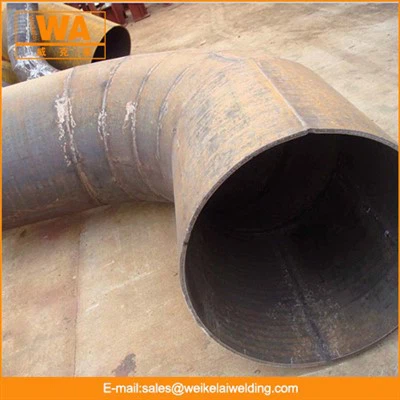
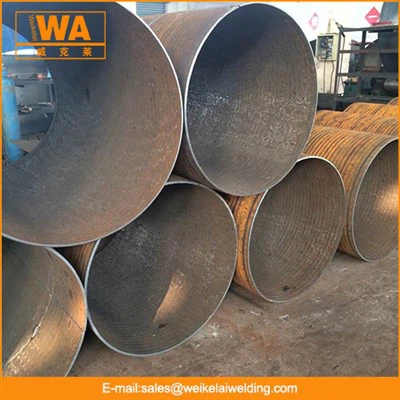
Hardfacing Pipe
WeiKeLai Welding Technology Co.,Ltd is a new generation science & technology enterprise. Relying on the advanced equipment, mature formulation of surfacing material and hardfacing process technique, we are committed to provide customer quality wear products & welding services at competitive prices.





Why choose us?
Our factory
Our company covers an area of 1530 square meters, More than 1,000 employees,with nearly 20 years of industry experience.
Production equipment
Drum welding equipment, flat welding machine, rolling machine, plasma cut machine, flux cored wire line, flat machine, welding machine.
Production market
US, Canada, Russia, Finland, Korea, Vietnam, New Zealand, Bulgaria, Brazil, Chile, Peru, Philippines, Italy, UK and China local market.
Quality assurance
The company strives to improve customer satisfaction through continual improvement of the quality management system, processes and the assurance of conformity to customer, statutory and/or regulatory requirements.
Decreased downtime instances
Adding up an extra layer of protection to your parts and components can help it become durable. Thus, reducing the instances of breakage, damage, and downtime. This is one of the many reasons why a lot of people go with hardfacing.
Longer lasting and more durable parts and components
Hardfacing, you not only get extra protection; your parts can also become abrasion and corrosion-resistant, too, making them last longer and become more durable.
Reduced costs
A significant reduction in cost is one of the most notable benefits of hardfacing. Because of the fact that it allows base metals to be stronger, tougher, and more durable, you will have fewer needs to repair and replace them – giving you relevant reduction in cost.
Better part performance
Imagine a chute without any type of hardfacing – do you think they’ll function properly? They absolutely will, for a time. However, if you continue to use it without any sort of protection, it’ll be damaged – and not for long, it can break. If it has a hardfacing coating, you can expect it not to wear down easily. Making it function better and more efficiently.
Reduced storage space needs
Hardfacing protects your parts and components to be worn out; reducing the need for you to store spare and back-up resources. In asking what hardfacing is, these benefits can clearly give you the answers you’re looking for.

●Pneumatic ash transport lines
●Limestone transfer lines
●Coal transfer lines
●Recycling facilities material handling lines
●Water treatment facilities pumping lines
●Concrete transfer lines
Techniques for Hard Facing
There are several hard-facing methods, each suitable to particular applications and operational situations. Among the most popular techniques are:
Arc welding technique (MMA, MIG, and TIG): Being among the most popular techniques, the arc welding method creates a hard-facing processes layer by using a disposable electrode. The three most common types, Gas Tungsten Arc Welding (GTAW), Gas Metal Arc Welding (GMAW), and Shielded Metal Arc Welding (SMAW), have been used for various purposes.
Thermal spraying: This technique creates a layer of protection on the outer layer by spraying melted or semi-molten material onto it. It is frequently employed to prevent rusting or damage at high temperatures.
Laser cladding: A more sophisticated technique called laser cladding employs laser energy to fuse wear-resistant material to the outer layer of the element, resulting in a precisely bonded, metallurgically sound, and durable coating.
Plasma transferred arc welding (PTA): With plasma arcs, material is deposited onto the workpiece during the more sophisticated process known as plasma transferred arc welding (PTA) welding. High deposition rates and superb control over the hard-faced layer’s quality and thickness are offered by it.
Oxy-Fuel Welding (OFW): This conventional technique, which is usually employed for low-cost applications, welds the hard facing material onto the workpiece using an oxy-acetylene flame.
Product Specifications
|
Pupular hardfacing pipe spec |
Thickness(mm) |
Min Pipe Radius(mm) |
|
6+4 |
10±0.5 |
R≥150 |
|
6+6 |
12±0.5 |
R≥150 |
|
8+6 |
14±0.5 |
R≥150 |
|
10+8 |
18±0.5 |
R≥300 |
|
10+10 |
20±0.5 |
R≥350 |
|
12+10 |
22±0.5 |
R≥350 |
Packaging And Delivery

Packaging
Package with metal strip and square tube
Thickness options
10mm(6+4); 12mm(6+6); 14mm(8+6); 16mm(8+8); 18mm(10+8); 20mm(10+10); 22mm(12+10); or customized
Width options
1200mm; 1500mm; 2200mm; or customized
Our Certificate

