


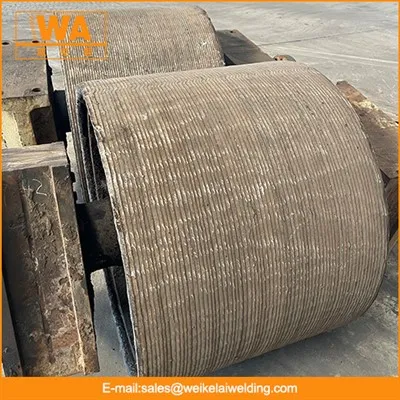
Welding Recondition
WeiKeLai Welding Technology Co.,Ltd is a new generation science & technology enterprise. Relying on the advanced equipment, mature formulation of surfacing material and hardfacing process technique, we are committed to provide customer quality wear products & welding services at competitive prices.



Why choose us?
Our factory
Our company covers an area of 1530 square meters, More than 1,000 employees,with nearly 20 years of industry experience.
Production equipment
Drum welding equipment, flat welding machine, rolling machine, plasma cut machine, flux cored wire line, flat machine, welding machine.
Production market
US, Canada, Russia, Finland, Korea, Vietnam, New Zealand, Bulgaria, Brazil, Chile, Peru, Philippines, Italy, UK and China local market.
Quality assurance
The company strives to improve customer satisfaction through continual improvement of the quality management system, processes and the assurance of conformity to customer, statutory and/or regulatory requirements.
Shielded Metal Arc Welding (SMAW)
Stick welding or SMAW is a welding process where a consumable electrode coated with a flux that melts and provides a gas shield during welding is used. This welding process is versatile and can be utilized to weld different types of metals and alloys.
Gas Tungsten Arc Welding (GTAW or TIG)
TIG welding or Gas Tungsten Arc Welding (GTAW) is a welding process where a non-consumable tungsten electrode is utilized to create the weld. It usually requires a separate filler metal to join the two metal parts.
Gas Metal Arc Welding (GMAW or MIG)
MIG welding or Gas Metal Arc Welding (GMAW) is a welding process that utilizes a continuous wire electrode and a shielding gas to prevent the weld from being contaminated. GMAW is a fast and efficient welding process and is frequently utilized in industrial and automotive applications.
Flux Cored Arc Welding (FCAW)
Flux Cored Arc Welding (FCAW) is a welding process that utilizes a tubular wire containing flux to provide a protective gas shield and additional filler metal. FCAW is a versatile process and can be applied to weld different types of metals, such as aluminum and stainless steel.
Submerged Arc Welding (SAW)
Submerged Arc Welding (SAW) is a welding process that employs granular flux to provide a protective gas shield and an additional filler metal source. SAW is commonly used in heavy industrial applications and is renowned for its high deposition rates and deep penetration.
Benefits of Welding Recondition


Cost-effectiveness: Welding repair is often more cost-effective than replacing parts, especially for minor damages or wear and tear. Instead of purchasing new components, welding allows you to restore the existing part to its functional state, saving on material and replacement costs.
Time efficiency: Repairing a component through welding can be quicker than sourcing and installing a new part, especially if the replacement part needs to be ordered or customized. This is particularly advantageous in situations where downtime needs to be minimized, such as in industrial settings or during equipment breakdowns.
Preservation of original integrity: Repairing a part through welding helps preserve the original integrity and design of the component. This is important for maintaining the compatibility and performance of the equipment or structure, as well as ensuring that critical specifications are met.
Reduced waste: Welding repair promotes sustainability by reducing waste. Instead of discarding damaged components and adding to landfill waste, welding allows you to extend the lifespan of the existing materials, minimizing environmental impact.
Customization and adaptation: Welding repair offers the flexibility to customize and adapt components to specific requirements. This can involve reinforcing weak points, modifying designs for improved functionality, or even combining multiple parts into a single structure, providing tailored solutions that may not be possible with off-the-shelf replacements.
Maintaining structural strength: Welding repair can often restore the structural integrity of a component, especially in cases where only localized damage has occurred. By effectively repairing cracks, fractures, or other defects, welding helps maintain the strength and stability of the overall structure or equipment.
Cost savings in the long run: While welding repair may involve upfront costs for labor and materials, it can lead to significant cost savings over the long run. By extending the lifespan of components and equipment, welding reduces the frequency of replacements and associated expenses, ultimately contributing to overall cost savings for businesses and individuals.
Flexibility in repairing complex structures: In many cases, replacing an entire complex structure may not be feasible or practical. Welding repair allows for targeted fixes on specific areas, preserving the rest of the structure and avoiding the need for extensive dismantling or reconstruction.

●Welding operators should always wear an approved respirator unless exposure assessments are below applicable exposure limits.
●Inspecting welding equipment and electrode holder before proceeding to work.
●Welders should not touch the metal parts of the electrode holder with skin or wet clothing.
●Wearing appropriate PPE like welding helmets and eye protection gear like goggles to protect workers’ eyes and head from hot slag, sparks, intense light, and chemical burns.
●Welding workers should remain in the work area for at least 30 minutes after finishing welding to ensure there are no smoldering fires.
Packaging And Delivery

Packaging
Package with metal strip and square tube
Thickness options
10mm(6+4); 12mm(6+6); 14mm(8+6); 16mm(8+8); 18mm(10+8); 20mm(10+10); 22mm(12+10); or customized
Width options
1200mm; 1500mm; 2200mm; or customized
Our Certificate

