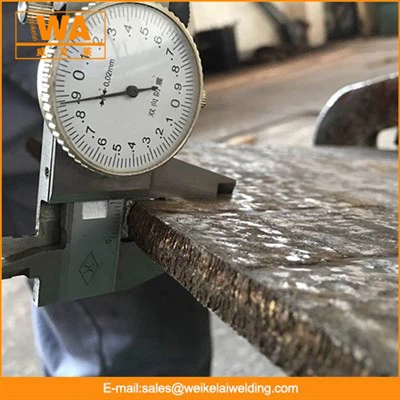
What is the density of open arc welding wire?
As a supplier of open arc welding wire, I often encounter various technical inquiries from customers, and one question that frequently comes up is about the density of open arc welding wire. Understanding the density of welding wire is crucial for several reasons, including accurate material calculations, process optimization, and quality control in welding operations.
The Concept of Density in Welding Wire
Density is defined as the mass per unit volume of a substance. In the context of open arc welding wire, it represents how much mass is contained within a given volume of the wire. The density of welding wire is influenced by several factors, primarily the chemical composition of the wire. Different alloys and elements have different atomic masses, which directly affect the overall density of the wire.
For example, welding wires made from steel, which is an alloy of iron and carbon with other elements, have a characteristic density based on the proportion of these elements. The addition of alloying elements such as manganese, silicon, nickel, and chromium can significantly alter the density of the wire. High - strength steel welding wires, which often contain more alloying elements, may have a slightly different density compared to mild steel welding wires.
Factors Affecting the Density of Open Arc Welding Wire
Chemical Composition
As mentioned earlier, the chemical composition is the most significant factor affecting the density of welding wire. For instance, High Chrome Core Wire contains a relatively high percentage of chromium. Chromium has a higher atomic mass compared to iron, so welding wires with a high chromium content will generally have a higher density than those with lower chromium or no chromium at all.


Manufacturing Process
The manufacturing process of the welding wire can also have an impact on its density. During the drawing and annealing processes, the wire's internal structure can be altered. If the wire is not properly annealed, it may have internal stresses that can affect its density. Additionally, the presence of voids or porosity in the wire, which can occur during manufacturing, can lower the overall density of the wire.
Coating and Flux
Many open arc welding wires are flux - cored or have a coating. The flux or coating material has its own density, and when combined with the base wire, it affects the overall density of the welding wire. Flux Cored Mig Wire and Dual Shield Welding Wire are examples of wires with flux that can change the density characteristics. The type and amount of flux used will determine the extent of the density change.
Measuring the Density of Open Arc Welding Wire
Measuring the density of welding wire can be done using a relatively simple method. First, a sample of the welding wire is weighed using a precise scale to obtain its mass. Then, the volume of the wire sample is determined. This can be done by measuring the length and diameter of the wire and using the formula for the volume of a cylinder (V = πr²h, where r is the radius and h is the length). Once the mass and volume are known, the density (ρ) can be calculated using the formula ρ = m/V, where m is the mass and V is the volume.
It's important to note that when measuring the density of flux - cored or coated welding wires, the mass and volume of the flux or coating should be considered separately if a more accurate density of the base wire is required.
Importance of Knowing the Density of Open Arc Welding Wire
Material Calculations
In welding projects, accurate material calculations are essential. Knowing the density of the welding wire allows for precise estimation of the amount of wire needed for a particular job. This helps in cost - control, as over - ordering or under - ordering of welding wire can lead to unnecessary expenses or project delays.
Welding Process Optimization
The density of the welding wire can affect the welding process. For example, a wire with a higher density may require different welding parameters such as voltage, current, and wire feed speed compared to a wire with a lower density. Understanding the density can help welders optimize these parameters to achieve better weld quality, including improved penetration, bead shape, and reduced spatter.
Quality Control
Density can also be used as an indicator of the quality of the welding wire. Significant deviations from the expected density may indicate issues with the chemical composition, manufacturing process, or the presence of defects in the wire. By regularly measuring the density of the welding wire, suppliers and users can ensure that the wire meets the required quality standards.
Our Offerings as an Open Arc Welding Wire Supplier
As a leading supplier of open arc welding wire, we offer a wide range of products with different densities to meet the diverse needs of our customers. Our High Chrome Core Wire is designed for applications that require high corrosion resistance and wear resistance. The high chromium content gives it a unique density and excellent performance in harsh environments.
Our Flux Cored Mig Wire is popular for its ease of use and high deposition rates. The flux in this wire not only affects its density but also provides shielding and alloying elements during the welding process, resulting in high - quality welds.
The Dual Shield Welding Wire is another product in our portfolio. It combines the advantages of flux - cored and gas - shielded welding, and its density is carefully engineered to ensure optimal performance in various welding applications.
Contact Us for Your Welding Wire Needs
If you are in the market for high - quality open arc welding wire and want to learn more about the density and other properties of our products, we encourage you to contact us. Our team of experts is ready to assist you in selecting the right welding wire for your specific requirements. Whether you are a small - scale welder or a large manufacturing company, we have the products and knowledge to support your welding projects.
References
- ASM Handbook Volume 6: Welding, Brazing, and Soldering. ASM International.
- Welding Metallurgy and Weldability of Stainless Steels. John C. Lippold, David J. Kotecki. Wiley.
- The Science and Practice of Welding. John F. Lancaster. Butterworth - Heinemann.