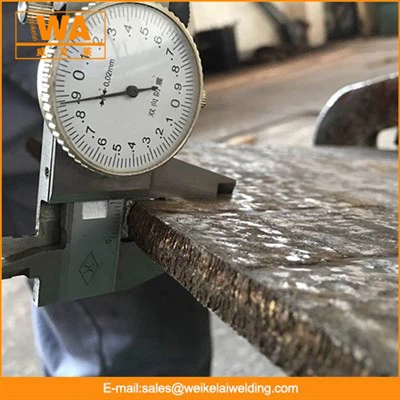
As a seasoned welding recondition supplier, I understand the critical role that heat input control plays in the welding reconditioning process. In this blog, I'll share some insights on how to effectively control heat input during welding recondition, which is essential for ensuring the quality and durability of the reconditioned parts.
Understanding Heat Input in Welding Recondition
Before delving into the control methods, it's important to understand what heat input is. Heat input in welding is the amount of energy transferred from the welding arc to the workpiece. It is typically measured in joules per centimeter (J/cm) or kilojoules per inch (kJ/in). Excessive heat input can lead to a variety of problems, such as distortion, reduced mechanical properties, and increased risk of cracking. On the other hand, insufficient heat input may result in incomplete fusion, lack of penetration, and weak weld joints.
Factors Affecting Heat Input
Several factors influence the heat input during welding recondition. These include:
- Welding Current: The welding current is directly proportional to the heat input. Higher current settings result in more heat being generated at the welding arc. However, increasing the current too much can cause overheating and other issues.
- Welding Voltage: The welding voltage also affects the heat input. Higher voltage settings increase the arc length and the amount of energy transferred to the workpiece. But, excessive voltage can lead to unstable arcs and poor weld quality.
- Welding Speed: The speed at which the welding torch moves along the joint is inversely proportional to the heat input. Faster welding speeds result in lower heat input, while slower speeds increase the heat input.
- Electrode Size and Type: The size and type of the electrode used in welding can impact the heat input. Larger electrodes generally require higher current settings, which can increase the heat input. Different electrode types also have different heat transfer characteristics.
Methods for Controlling Heat Input
Now that we understand the factors affecting heat input, let's explore some methods for controlling it during welding recondition.
1. Optimize Welding Parameters
- Current and Voltage Selection: Carefully select the appropriate welding current and voltage based on the thickness and type of the workpiece, as well as the welding process being used. Consult welding procedure specifications (WPS) or seek advice from experienced welders to determine the optimal settings.
- Welding Speed Adjustment: Adjust the welding speed to maintain a consistent heat input. If the weld is starting to overheat, increase the welding speed. Conversely, if there is insufficient fusion, slow down the welding speed.
2. Use Heat Sinks
Heat sinks are materials that can absorb and dissipate heat from the workpiece. They can be used to control the heat input during welding recondition by reducing the temperature rise in the surrounding area. Common heat sink materials include copper, aluminum, and graphite. Place the heat sink near the welding joint to draw heat away from the workpiece.
3. Preheating and Post - heating
- Preheating: Preheating the workpiece before welding can help reduce the temperature gradient between the weld and the base metal, which in turn reduces the heat input required to achieve proper fusion. Preheating also helps to prevent cracking and improve the weldability of certain materials.
- Post - heating: Post - heating the welded part can relieve residual stresses and improve the mechanical properties of the weld. It involves heating the part to a specific temperature after welding and holding it for a certain period of time.
4. Welding Technique
- Backstepping and Skip Welding: These techniques involve welding in short segments and alternating the direction of welding to distribute the heat more evenly along the joint. Backstepping involves welding in a series of short lengths, each one overlapping the previous one in the opposite direction. Skip welding involves leaving gaps between weld segments and then filling them in later.
- Intermittent Welding: Instead of continuous welding, intermittent welding can be used to reduce the overall heat input. This involves welding for a short period of time and then allowing the workpiece to cool before resuming welding.
Case Studies in Heat Input Control
Let's take a look at some real - world examples where effective heat input control was crucial in welding recondition.
Roller Welding Repair
In Roller Welding Repair, rollers are often subjected to high - stress conditions. Controlling the heat input during the repair process is essential to prevent distortion and maintain the dimensional accuracy of the rollers. By carefully selecting the welding parameters and using heat sinks, we were able to successfully repair rollers with minimal heat - related issues.
Coal Pulverizer Tables
Coal Pulverizer Tables are critical components in coal - fired power plants. Welding recondition of these tables requires precise heat input control to ensure the integrity of the welds and the long - term performance of the tables. Through the use of optimized welding parameters and proper preheating, we were able to achieve high - quality welds and extend the service life of the coal pulverizer tables.
Welding Rebuild On Roller
When performing Welding Rebuild On Roller, it is important to control the heat input to avoid overheating the roller and causing damage to its surface. By adjusting the welding speed and using intermittent welding techniques, we were able to rebuild the rollers effectively while maintaining their mechanical properties.
Importance of Heat Input Control in Welding Recondition
Controlling the heat input during welding recondition offers several benefits:
- Improved Weld Quality: Proper heat input control ensures complete fusion, good penetration, and a smooth weld bead. It reduces the risk of defects such as porosity, cracking, and lack of fusion, resulting in higher - quality welds.
- Reduced Distortion: By minimizing the heat input, we can reduce the thermal stresses in the workpiece, which helps to prevent distortion. This is particularly important for parts with tight dimensional tolerances.
- Enhanced Mechanical Properties: Controlling the heat input can improve the mechanical properties of the weld, such as strength, toughness, and ductility. This ensures that the reconditioned parts can withstand the intended service conditions.
Conclusion
In conclusion, controlling the heat input during welding recondition is a critical aspect of ensuring high - quality welds and the long - term performance of reconditioned parts. By understanding the factors affecting heat input, implementing appropriate control methods, and learning from real - world case studies, we can achieve optimal results in welding recondition.


If you are in need of reliable welding recondition services or have any questions about heat input control in welding, we are here to help. Our team of experienced welders and engineers is dedicated to providing high - quality solutions tailored to your specific needs. Contact us today to discuss your requirements and start a procurement negotiation.
References
- AWS Welding Handbook, American Welding Society
- Welding Metallurgy and Weldability of Stainless Steels, John C. Lippold and David J. Kotecki
- Welding Processes and Practices, Richard L. Petzold