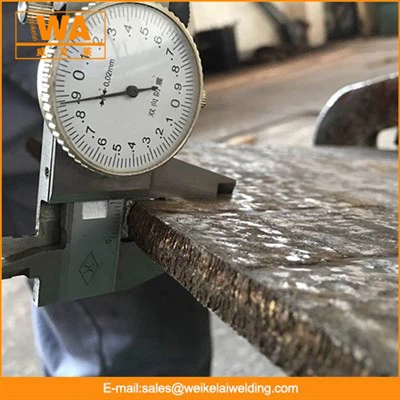
Hey there! As a supplier of Metallic Wear Liners, I often get asked about the thermal conductivity of these liners. So, I thought I'd take a deep - dive into this topic and share what I know.
First off, let's understand what thermal conductivity is. Simply put, thermal conductivity is a measure of a material's ability to conduct heat. In the context of metallic wear liners, it's a crucial property because these liners are often used in environments where they're exposed to high temperatures or need to transfer heat efficiently.
Metallic wear liners are made from various metals and metal alloys, and each of these materials has a different thermal conductivity. For example, copper and aluminum are well - known for their high thermal conductivity. Copper has a thermal conductivity of around 401 W/(m·K) at room temperature, while aluminum has a thermal conductivity of about 237 W/(m·K). These high values mean that copper and aluminum can transfer heat very quickly.


On the other hand, metals like stainless steel have relatively lower thermal conductivity. The thermal conductivity of austenitic stainless steel (a common type) is around 15 W/(m·K). This lower value indicates that stainless steel doesn't transfer heat as rapidly as copper or aluminum.
Now, why does the thermal conductivity of metallic wear liners matter? Well, in industries such as mining, cement production, and power generation, these liners are used in chutes and mills. In a chute, materials are often hot when they're being transported. A liner with high thermal conductivity can quickly transfer the heat away from the material, reducing the risk of heat - related damage to the chute structure. You can check out more about Chute Wear Liners on our website.
In mills, the grinding process generates a lot of heat. If the wear liners can't dissipate this heat effectively, it can lead to overheating, which may cause the liners to warp or lose their wear - resistant properties. Chromium Alloy Steel Mill Liners are often used in mills, and their thermal conductivity plays a key role in maintaining the efficiency and longevity of the mill.
When we select the right metallic wear liner for a specific application, we need to consider the thermal environment. If the application involves high - temperature materials or a lot of heat generation, we'd typically look for a liner with high thermal conductivity. But it's not just about thermal conductivity. We also need to consider other factors like wear resistance, hardness, and cost.
Let's talk a bit more about the factors that can affect the thermal conductivity of metallic wear liners. One important factor is the alloy composition. Adding different elements to a base metal can change its thermal conductivity. For instance, adding nickel to steel can slightly increase its thermal conductivity in some cases, while adding chromium can have a more complex effect depending on the amount and the overall alloy structure.
The microstructure of the metal also plays a role. A fine - grained microstructure can sometimes increase thermal conductivity compared to a coarse - grained one. This is because heat transfer in metals occurs mainly through the movement of free electrons, and a fine - grained structure can provide a more efficient path for these electrons.
Another factor is the presence of impurities. Impurities can act as scattering centers for electrons, reducing the thermal conductivity. So, during the manufacturing process of metallic wear liners, we need to ensure a high - quality material with minimal impurities.
Now, let's touch on how we test the thermal conductivity of these liners. There are several methods available. One common method is the guarded hot plate method. In this method, a sample of the liner is placed between a hot plate and a cold plate. The heat flow through the sample is measured, and from this, the thermal conductivity can be calculated. Another method is the laser flash method, which is quicker and can be used for small samples. It involves heating one side of the sample with a laser pulse and measuring the temperature rise on the other side.
As a supplier of Metallic Wear Liners, we understand the importance of providing liners with the right thermal conductivity for different applications. We work closely with our customers to understand their needs, whether it's a high - temperature chute application or a heat - generating mill process.
If you're in the market for metallic wear liners, don't just focus on the price. Think about the long - term performance, and the thermal conductivity is a big part of that. A liner with the right thermal conductivity can save you money in the long run by reducing maintenance costs and increasing the lifespan of your equipment.
In conclusion, the thermal conductivity of metallic wear liners is a complex but important property. It affects how these liners perform in different industrial applications, and we need to consider it along with other factors when selecting the right liner. Whether you're dealing with high - temperature materials or a heat - intensive process, choosing the right liner can make a big difference.
If you're interested in learning more about our metallic wear liners or have a specific application in mind, I encourage you to reach out to us. We're here to help you find the best solution for your needs. Let's have a chat and see how we can work together to improve your operations.
References
- Incropera, F. P., & DeWitt, D. P. (2002). Fundamentals of Heat and Mass Transfer. John Wiley & Sons.
- Callister, W. D., & Rethwisch, D. G. (2010). Materials Science and Engineering: An Introduction. John Wiley & Sons.