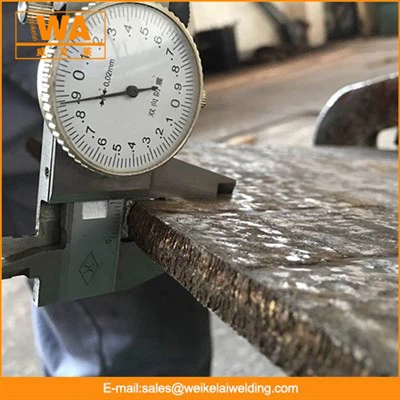
Hey there! As a supplier of Overlay Wear Plates, I often get asked about the load - bearing capacity of these plates. So, I thought I'd write this blog to share some insights on this topic.
First off, let's understand what overlay wear plates are. Overlay wear plates are composite materials made by depositing a wear - resistant alloy onto a base plate. The base plate provides the structural strength, while the overlay layer offers excellent wear resistance. These plates are used in a wide range of industries, including mining, construction, and manufacturing, where there's a lot of abrasion, impact, and sliding wear.


Now, let's talk about load - bearing capacity. The load - bearing capacity of overlay wear plates depends on several factors. One of the most important factors is the type of base plate used. Different base plates have different mechanical properties, such as yield strength and tensile strength, which directly affect the load - bearing capacity.
For example, a High Hardness Steel Plate is known for its high strength and hardness. It can withstand heavy loads and is often used in applications where there's a high level of stress. The high hardness of the steel plate means that it can resist deformation under load, making it a great choice for applications with high load - bearing requirements.
Another type of base plate is the Hardox Steel Plate. Hardox is a brand of wear - resistant steel that's very popular in the industry. It has excellent toughness and wear resistance, and it can handle both static and dynamic loads well. Whether it's a continuous heavy load or an impact load, Hardox steel plates can usually stand up to the challenge.
The Manganese Wear Plate is also an option. Manganese steel has unique properties. When it's subjected to impact, its surface hardens, which can enhance its load - bearing capacity in impact - prone applications. For example, in a mining operation where rocks are constantly hitting the plates, a manganese wear plate can harden over time and continue to support the load effectively.
The thickness of the base plate also plays a crucial role in determining the load - bearing capacity. A thicker base plate generally has a higher load - bearing capacity. However, it's not just about the thickness. The ratio of the thickness of the overlay layer to the base plate also matters. If the overlay layer is too thick relative to the base plate, it can cause problems. For instance, it might lead to increased stress concentrations at the interface between the overlay and the base plate, which could reduce the overall load - bearing capacity.
The manufacturing process of the overlay wear plates is another factor. A well - manufactured plate will have a good bond between the overlay and the base plate. If the bond is weak, the overlay might delaminate under load, which can significantly reduce the load - bearing capacity. Our company uses advanced welding and deposition techniques to ensure a strong and uniform bond between the layers. This helps to maintain the integrity of the plate under load and ensures that it can support the intended weight.
The application environment also affects the load - bearing capacity. In a corrosive environment, the base plate and the overlay can be damaged over time. Corrosion can reduce the thickness of the plate and weaken its structure, thus decreasing its load - bearing capacity. Similarly, in high - temperature environments, the mechanical properties of the materials can change. Some steels might lose their strength at high temperatures, which means that the load - bearing capacity of the overlay wear plate will also be affected.
To determine the load - bearing capacity of an overlay wear plate for a specific application, engineers usually perform calculations and tests. They consider the factors I mentioned above, as well as the specific requirements of the application, such as the type of load (static or dynamic), the frequency of the load, and the expected service life of the plate.
In real - world applications, the load - bearing capacity of overlay wear plates is put to the test every day. In a mining truck's dump body, for example, the overlay wear plates need to support the weight of tons of ore. The plates have to withstand the continuous abrasion from the rough ore and the impact when the ore is loaded and unloaded. Our overlay wear plates have been used in many such applications, and they've proven to be reliable in handling these heavy loads.
In a construction equipment like a bulldozer blade, the overlay wear plates need to bear the load of pushing large amounts of soil and rocks. The plates need to be strong enough to resist the forces generated during the pushing operation. Again, our plates have shown good performance in these scenarios.
If you're in an industry that requires overlay wear plates and you're concerned about the load - bearing capacity, don't hesitate to reach out. We have a team of experts who can help you choose the right overlay wear plates for your specific needs. We can provide detailed information about the load - bearing capacity of our products and how they can be optimized for your application. Whether it's a small - scale project or a large - scale industrial operation, we're here to assist you.
In conclusion, the load - bearing capacity of overlay wear plates is a complex topic that depends on multiple factors, including the type of base plate, its thickness, the manufacturing process, and the application environment. By understanding these factors, you can make an informed decision when choosing overlay wear plates for your business. If you have any questions or if you're interested in purchasing our overlay wear plates, feel free to contact us for a consultation. We're eager to work with you to find the best solutions for your load - bearing and wear - resistance needs.
References
- Materials Science and Engineering textbooks
- Industry reports on wear - resistant materials
- Technical data sheets from steel manufacturers