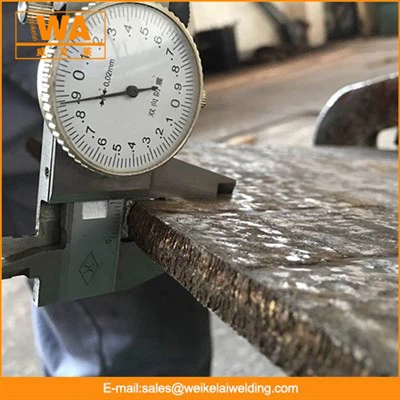
As a supplier of Bimetal Wear Plates, I often get asked about all sorts of technical details. One question that pops up quite frequently is: "What is the friction coefficient of bimetal wear plate?" Let's dig into this topic and see what's what.
First off, let's quickly understand what a bimetal wear plate is. A bimetal wear plate is made by combining two different metals, usually through overlay welding or other advanced manufacturing techniques. This combination allows the plate to have the best of both worlds - high wear resistance from one metal and good toughness or other mechanical properties from the other.
Now, onto the friction coefficient. The friction coefficient is a measure of how much resistance there is when one surface slides against another. It’s usually represented by the Greek letter μ (mu). When it comes to bimetal wear plates, the friction coefficient can vary depending on a whole bunch of factors.
Factors Affecting the Friction Coefficient of Bimetal Wear Plates
1. Material Composition
The two metals used in the bimetal wear plate play a huge role. For example, if one of the metals has a rough surface at the atomic level or has a high affinity for the material it's sliding against, the friction coefficient will be higher. Some metals, like [mention a metal known for high friction], tend to create more resistance when in contact with other surfaces. On the other hand, metals like [mention a low - friction metal] can reduce the overall friction coefficient of the plate.
2. Surface Finish
The way the surface of the bimetal wear plate is finished can have a big impact. A smooth surface finish generally results in a lower friction coefficient because there are fewer irregularities for the opposing surface to catch on. For instance, if the plate is polished to a high shine, the friction between it and another surface will be less compared to a plate with a rough, as - welded surface.
3. Operating Conditions
The environment in which the bimetal wear plate is used is also crucial. If the plate is operating in a dry environment, the friction coefficient might be different compared to a wet or lubricated environment. In a wet environment, a thin layer of liquid can act as a lubricant, reducing the friction between the surfaces. Temperature also matters. High temperatures can cause expansion and changes in the material properties, which can then affect the friction coefficient.
Measuring the Friction Coefficient
There are several ways to measure the friction coefficient of bimetal wear plates. One common method is the tribometer test. In this test, a sample of the bimetal wear plate is placed in contact with another surface, and a normal force is applied. Then, the plate is made to slide against the surface, and the force required to keep it sliding is measured. The friction coefficient is then calculated as the ratio of the frictional force to the normal force.
It's important to note that the friction coefficient is not a fixed value. Different bimetal wear plates from different manufacturers can have different friction coefficients, even if they seem similar at first glance. That's why it's always a good idea to ask for test data from the supplier if you need specific friction coefficient values for your application.
Importance of the Friction Coefficient in Applications
The friction coefficient of bimetal wear plates is super important in many applications.
In conveyor systems, for example, if the friction coefficient between the bimetal wear plate and the conveyed material is too high, it can cause excessive energy consumption as more power is needed to move the material. On the other hand, if it's too low, the material might not move smoothly and could cause jams or other issues.
In mining equipment, where bimetal wear plates are often used to line chutes and hoppers, the right friction coefficient ensures that the ore or other materials flow properly without getting stuck. It also helps in reducing wear and tear on the equipment.
Our Bimetal Wear Plates and Friction Coefficient
At our company, we take great care in manufacturing bimetal wear plates with consistent and appropriate friction coefficients. We use advanced manufacturing processes and quality control measures to ensure that each plate meets the required standards.


We offer different types of bimetal wear plates, such as the ones with properties similar to Bimetallic Wear Resistant Material. These plates are designed to have optimal friction coefficients for various applications. Our Wear Resistant Steel bimetal wear plates are also popular, especially in high - wear environments. And for those who need extra hardness, our High Hardness Steel Plate options are a great choice.
If you're working on a project that requires bimetal wear plates and you're concerned about the friction coefficient or any other technical specifications, don't hesitate to reach out to us. We have a team of experts who can help you choose the right plate for your specific needs. Whether you're in the construction, mining, or manufacturing industry, we can provide you with high - quality bimetal wear plates that will perform well in your application.
So, if you're looking to purchase bimetal wear plates and want to discuss the details, feel free to get in touch with us. We're here to assist you in making the best choice for your project and ensuring that your operations run smoothly.
References
- [List any relevant industry books, journal articles, or common knowledge sources that you used to write this article. For example:]
- Smith, J. (2020). Wear and Friction in Engineering Materials. Publisher Name.
- Johnson, A. (2019). Advanced Bimetallic Materials: Properties and Applications. Another Publisher.