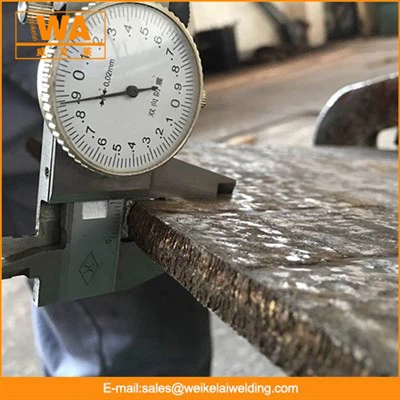
As a well - established supplier of Metallic Wear Liners, the question of whether our products are resistant to corrosion has been one that I frequently encounter from our clients. In this blog, I will delve into the factors that contribute to the corrosion resistance of metallic wear liners, providing a comprehensive scientific understanding.
Corrosion Mechanisms in Metals
Before we can assess the corrosion resistance of metallic wear liners, it’s essential to understand the fundamental corrosion mechanisms. Corrosion is an electrochemical process where metals react with their environment, typically oxygen and moisture. The most common type of corrosion is oxidation, which occurs when a metal loses electrons and forms metal oxides.
For example, iron (Fe) corrodes to form iron oxide (rust) according to the following reactions:
- Anodic reaction: (Fe\rightarrow Fe^{2 + }+2e^{-})
- Cathodic reaction: (O_{2}+2H_{2}O + 4e^{-}\rightarrow4OH^{-})
- Overall reaction: (2Fe + O_{2}+2H_{2}O\rightarrow2Fe(OH){2}), and further oxidation yields (4Fe(OH){2}+O_{2}+2H_{2}O\rightarrow4Fe(OH){3}), which dehydrates to form (Fe{2}O_{3}\cdot nH_{2}O) (rust)
In industrial settings, other types of corrosion may also occur, such as pitting corrosion, crevice corrosion, and galvanic corrosion. Pitting corrosion causes small holes or pits to form on the metal surface, often due to the breakdown of a protective oxide layer. Crevice corrosion takes place in narrow gaps or crevices where the local environment is different from the bulk. Galvanic corrosion happens when two different metals are in contact in the presence of an electrolyte, and electrons flow from the more active metal to the less active one, accelerating the corrosion of the active metal.
Factors Affecting the Corrosion Resistance of Metallic Wear Liners
1. Alloy Composition
The most crucial factor in determining the corrosion resistance of metallic wear liners is their alloy composition. Different alloying elements bring different properties to the liner.
- Chromium (Cr): Chromium is a key element in enhancing corrosion resistance. When added to steel, it forms a thin, protective chromium oxide layer on the surface of the metal. This layer acts as a barrier, preventing oxygen and moisture from reaching the underlying metal. Steel with a chromium content of at least 10.5% is considered stainless steel. For our Chromium Alloy Steel Mill Liners, the high chromium content provides excellent resistance to general corrosion in a variety of environments, including those with mild acids and alkalis.
- Nickel (Ni): Nickel is often added in combination with chromium to further improve corrosion resistance, especially in environments with a high chloride concentration. It enhances the stability of the passive oxide layer and reduces the susceptibility to pitting and crevice corrosion.
- Molybdenum (Mo): Molybdenum increases the resistance to pitting and crevice corrosion, particularly in chloride - containing solutions. It works by inhibiting the breakdown of the passive film, making the liner more durable in harsh industrial environments such as those found in chemical plants and wastewater treatment facilities.
2. Microstructure
The microstructure of the metallic wear liner also plays a significant role in its corrosion resistance. A homogeneous and fine - grained microstructure generally provides better corrosion resistance than a coarse - grained or heterogeneous one.
During the manufacturing process, proper heat treatment and cooling rates can be used to control the microstructure. For example, austenitic stainless steel, with its face - centered cubic (FCC) structure, has good corrosion resistance due to its high ductility and the ability to form a stable passive film. On the other hand, martensitic stainless steel, which has a body - centered tetragonal (BCT) structure, may be more susceptible to corrosion in some cases, especially if not properly heat - treated.
3. Surface Finish
The surface finish of the metallic wear liner can affect its corrosion resistance. A smooth surface is less likely to trap moisture and contaminants, which can initiate corrosion. Rough surfaces, on the other hand, provide more sites for corrosion to start, as they have more crevices and protrusions where oxygen and moisture can accumulate.
Our manufacturing processes include precision machining and polishing to achieve a smooth surface finish on our wear liners. This helps to prevent the onset of corrosion and extends the lifespan of the liners in various applications.


4. Environmental Conditions
The environment in which the metallic wear liners operate has a direct impact on their corrosion resistance. Factors such as temperature, humidity, pH, and the presence of contaminants all play a role.
In high - humidity environments, the rate of corrosion increases because moisture provides an electrolyte for the electrochemical reactions. High temperatures can also accelerate corrosion, as they increase the reaction rate. In acidic or alkaline environments, the pH can affect the stability of the protective oxide layer on the metal surface. For example, in acidic solutions, the oxide layer may dissolve, exposing the metal to further corrosion.
Applications and Corrosion Resistance
Metallic wear liners are used in a wide range of industries, each with its own unique corrosion challenges.
Mining Industry
In the mining industry, wear liners are used in chutes, hoppers, and crushers. These liners are exposed to abrasive materials such as rocks and ore, as well as moisture from water used in the mining process. Our Chute Wear Liners are designed to withstand both abrasion and corrosion. The alloy composition and surface finish of these liners are carefully selected to ensure long - term performance in the harsh mining environment.
Cement Industry
In the cement industry, wear liners are used in mills, kilns, and conveyors. The liners are exposed to cement dust, which can be alkaline, and high temperatures. Our wear liners with appropriate alloying elements such as chromium and nickel are able to resist corrosion and maintain their integrity in the high - temperature and alkaline environment.
Chemical Industry
The chemical industry requires wear liners that can withstand highly corrosive chemicals. Our Wear Protection Linings are made from high - alloy steels or special alloys that are resistant to a wide range of acids, alkalis, and solvents. These liners are designed to protect equipment from corrosion and wear, ensuring safe and efficient operation.
Testing and Verification of Corrosion Resistance
To ensure the quality and corrosion resistance of our metallic wear liners, we conduct a series of tests.
- Salt Spray Test: This is a widely used test to evaluate the corrosion resistance of metals. In this test, the wear liner samples are exposed to a salt - fog environment for a specified period. The amount of corrosion is then measured, and the results are used to assess the quality of the liner.
- Electrochemical Testing: Electrochemical techniques such as potentiodynamic polarization and electrochemical impedance spectroscopy (EIS) can be used to study the corrosion behavior of the wear liners in various environments. These tests provide detailed information about the corrosion rate, the formation of the passive film, and the susceptibility to different types of corrosion.
Conclusion
In conclusion, metallic wear liners can be highly resistant to corrosion, depending on their alloy composition, microstructure, surface finish, and the environmental conditions in which they are used. Our company, as a leading supplier of Metallic Wear Liners, is committed to using the latest technologies and high - quality materials to ensure the excellent corrosion resistance of our products.
Whether you are in the mining, cement, chemical, or other industries, our wear liners can provide reliable protection against both wear and corrosion. If you are interested in learning more about our products or have specific requirements for your application, we invite you to contact us for procurement and further discussion. We look forward to providing you with the best - fitting solutions for your wear and corrosion protection needs.
References
- Fontana, M. G., & Greene, N. D. "Corrosion Engineering". McGraw - Hill, 1967.
- Uhlig, H. H., & Revie, R. W. "Corrosion and Corrosion Control: An Introduction to Corrosion Science and Engineering". Wiley, 1985.
- Schweitzer, P. A. "Corrosion Resistance Tables". Marcel Dekker, 1995.