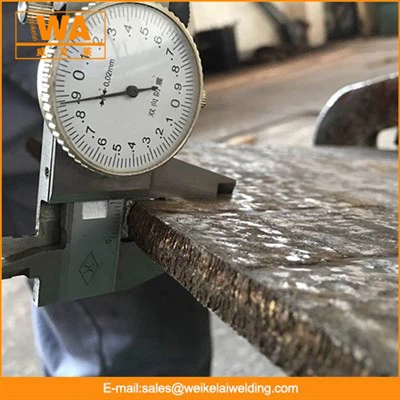
Yo, fellow welders! As a supplier of Flux Cored Arc welding products, I've seen firsthand the importance of having strong, fatigue - resistant welds. Fatigue strength is a big deal in welding because it determines how well a weld can withstand repeated loading and unloading over time. In this blog, I'm gonna share some tips on how to enhance the fatigue strength of the weld in Flux Cored Arc welding.
1. Select the Right Flux Cored Wire
First things first, the type of flux cored wire you choose can have a huge impact on the fatigue strength of your weld. We offer a variety of wires, like the Stainless Steel Mig Flux Cored Wire. This wire is great for applications where corrosion resistance and high - quality welds are needed. Stainless steel has good mechanical properties that can contribute to better fatigue resistance.
Another option is the Hardfacing Flux Cored Wire. If you're working on projects that require resistance to wear and abrasion, this wire is your go - to. The hardfacing layer it creates can also improve the overall fatigue performance of the weld by protecting the base metal from damage.
And then there's the Seamless Flux Cored Wire. Seamless wires are known for their consistent quality and smooth feeding. This consistency translates into more uniform welds, which are less likely to have weak spots that could lead to fatigue failure.
2. Prepare the Base Metal Properly
Before you start welding, you gotta make sure the base metal is clean and prepped. Any dirt, rust, or oil on the surface can cause defects in the weld, which will significantly reduce its fatigue strength. Use a wire brush or a grinder to clean the area where you'll be welding. You may also need to remove any mill scale, as it can prevent proper fusion between the wire and the base metal.
Preheating the base metal can also be beneficial. It helps to reduce the cooling rate of the weld, which in turn can prevent the formation of hard and brittle microstructures. These brittle structures are more prone to cracking under cyclic loading, so by preheating, you're giving your weld a better chance of withstanding fatigue.
3. Control the Welding Parameters
The welding parameters you set can make or break the fatigue strength of your weld. Let's start with the welding current. If the current is too high, the weld pool will be too large, and you may end up with a wide, shallow weld. This type of weld has a lower cross - sectional area, which means it can't handle as much stress during cyclic loading. On the other hand, if the current is too low, the fusion between the wire and the base metal may be poor, leading to lack of penetration and weak welds.
The voltage also plays a crucial role. A proper voltage setting ensures a stable arc and good bead shape. Too high a voltage can cause excessive spatter and a rough weld surface, while too low a voltage can result in a narrow, irregular bead.
The travel speed is another important parameter. If you travel too fast, the weld will be thin and may not have enough time to fully fuse with the base metal. If you travel too slow, the heat input will be too high, and you may overheat the base metal, causing distortion and reducing the fatigue strength.
4. Use the Right Welding Technique
The way you hold the welding gun and move it along the joint can affect the fatigue strength of the weld. For Flux Cored Arc welding, a back - and - forth or a weaving motion can be used. This helps to distribute the heat evenly and ensures better fusion. However, you need to be careful not to over - weave, as this can create voids and porosity in the weld.
A consistent gun angle is also important. A proper gun angle ensures that the wire is fed into the weld pool at the right position, which promotes good fusion and a uniform weld bead.


5. Post - Weld Treatment
After you've finished welding, there are some post - weld treatments you can do to enhance the fatigue strength. One of the most common treatments is stress relieving. This involves heating the welded part to a specific temperature and holding it there for a certain period of time. Stress relieving helps to reduce the residual stresses in the weld, which are caused by the rapid heating and cooling during the welding process. These residual stresses can act as stress concentrators, making the weld more susceptible to fatigue cracking.
Another post - weld treatment is shot peening. This process involves bombarding the weld surface with small metal shots. The impact of the shots creates compressive stresses on the surface of the weld. Compressive stresses are beneficial because they oppose the tensile stresses that occur during cyclic loading, effectively increasing the fatigue strength of the weld.
6. Quality Inspection
Once you've completed all the steps, it's essential to inspect the weld for any defects. Visual inspection is the first step. Look for any obvious signs of cracks, porosity, or lack of fusion. You can also use non - destructive testing methods like ultrasonic testing or magnetic particle testing to detect internal defects that may not be visible to the naked eye.
If you find any defects, you need to repair them immediately. Defects in the weld can act as stress raisers, which will significantly reduce the fatigue strength. By fixing these defects, you're ensuring that your weld can perform well under cyclic loading.
Conclusion
Enhancing the fatigue strength of the weld in Flux Cored Arc welding is a multi - step process. It involves selecting the right wire, preparing the base metal, controlling the welding parameters, using the proper welding technique, performing post - weld treatments, and conducting quality inspections.
As a Flux Cored Arc welding supplier, we're here to support you every step of the way. We have a wide range of high - quality flux cored wires and can provide you with expert advice on welding parameters and techniques. If you're interested in improving the fatigue strength of your welds and want to learn more about our products, don't hesitate to reach out. We're always ready to help you find the best solutions for your welding needs.
References
- AWS Welding Handbook, Volume 1: Welding Science and Technology.
- ASME Boiler and Pressure Vessel Code, Section IX: Welding and Brazing Qualifications.
- Welding Metallurgy by John C. Lippold and David L. Kotecki.