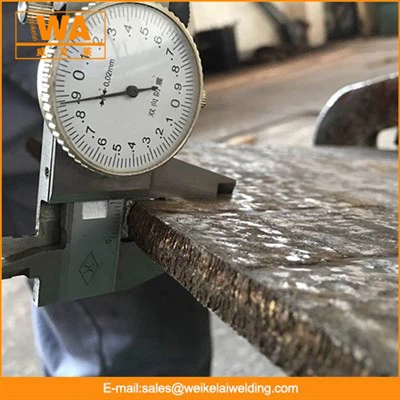
Roller welding repair plays a crucial role in the glass industries, ensuring the smooth operation of production lines and the quality of glass products. As a leading Roller Welding Repair supplier, we understand the specific requirements and challenges in this field. In this blog, we will explore the key requirements for roller welding repair in the glass industries.
Material Compatibility
One of the primary requirements for roller welding repair in the glass industries is material compatibility. Rollers in glass manufacturing are often subjected to high temperatures, abrasive wear, and chemical corrosion. Therefore, the welding materials used for repair must be able to withstand these harsh conditions and be compatible with the base material of the roller.
When selecting welding materials, we need to consider factors such as the chemical composition, mechanical properties, and thermal expansion coefficient of the base material. For example, if the roller is made of a high - alloy steel, the welding material should have similar alloying elements to ensure good bonding and similar performance under high - temperature conditions. In addition, the welding material should have excellent wear resistance and corrosion resistance to extend the service life of the repaired roller.
Precision and Accuracy
Precision and accuracy are essential in roller welding repair. In the glass industries, rollers are used to shape and transport glass products, and even a small deviation in the roller's surface profile or diameter can lead to defects in the glass. Therefore, during the welding repair process, we must ensure that the repaired roller meets the strict dimensional and geometric requirements.
We use advanced measurement and inspection equipment, such as coordinate measuring machines (CMM) and laser scanners, to accurately measure the roller's original dimensions and surface profile before welding. Based on these measurements, we develop a precise welding plan to ensure that the repaired roller has the correct diameter, straightness, and surface finish. During the welding process, we also use advanced welding techniques, such as automated welding, to ensure consistent and accurate weld deposition.
Heat Management
Heat management is another critical requirement for roller welding repair in the glass industries. Welding generates a significant amount of heat, which can cause thermal distortion and residual stress in the roller. These issues can affect the roller's performance and lead to premature failure.


To manage heat effectively, we use pre - heating and post - heating techniques. Pre - heating the roller before welding helps to reduce the temperature gradient between the weld and the base material, minimizing the risk of thermal cracking. Post - heating, on the other hand, helps to relieve residual stress and improve the mechanical properties of the weld.
In addition, we also control the welding parameters, such as welding current, voltage, and welding speed, to ensure that the heat input is within the acceptable range. By carefully managing heat, we can ensure that the repaired roller has good dimensional stability and mechanical properties.
Weld Quality
The quality of the weld is of utmost importance in roller welding repair. A poor - quality weld can lead to cracks, porosity, and other defects, which can compromise the roller's performance and safety.
We follow strict quality control procedures throughout the welding repair process. Before welding, we thoroughly clean the roller's surface to remove any contaminants, such as oil, rust, and scale. This ensures good adhesion between the weld and the base material. During the welding process, we use non - destructive testing methods, such as ultrasonic testing and magnetic particle testing, to detect any internal defects in the weld. After welding, we also perform mechanical testing, such as hardness testing and tensile testing, to ensure that the weld has the required mechanical properties.
Surface Finish
The surface finish of the repaired roller is also a critical requirement in the glass industries. A smooth and uniform surface finish is essential for the proper shaping and transportation of glass products.
After welding, we use various surface finishing techniques, such as grinding, polishing, and honing, to achieve the desired surface finish. These techniques help to remove any weld beads and irregularities on the roller's surface, ensuring that the roller has a smooth and consistent surface. We also pay attention to the surface texture, as a proper surface texture can improve the roller's grip on the glass and prevent slippage.
Compliance with Industry Standards
In the glass industries, roller welding repair must comply with various industry standards and regulations. These standards ensure the safety and quality of the repaired rollers.
We are committed to complying with all relevant industry standards, such as ISO 9001 for quality management systems and ASME codes for welding procedures. Our welding procedures are developed and qualified in accordance with these standards, and our welders are trained and certified to ensure that they have the necessary skills and knowledge to perform high - quality welding repairs.
Related Services
In addition to roller welding repair, we also offer related services to meet the diverse needs of our customers in the glass industries. For example, we provide Repair Coal Mill Table Liners, which is an important service for coal - fired power plants that are often associated with the glass manufacturing process. We also offer Welding Rebuild On Table Liner and Welding Rebuild On Roller services to help our customers extend the service life of their equipment.
Conclusion
Roller welding repair in the glass industries requires strict adherence to a series of requirements, including material compatibility, precision and accuracy, heat management, weld quality, surface finish, and compliance with industry standards. As a professional Roller Welding Repair supplier, we have the expertise, experience, and advanced equipment to meet these requirements and provide high - quality welding repair services to our customers in the glass industries.
If you are in need of roller welding repair services or have any questions about our services, please feel free to contact us for further discussion and procurement negotiation. We are committed to providing you with the best solutions to meet your specific needs.
References
- ASME Boiler and Pressure Vessel Code.
- ISO 9001:2015 Quality management systems - Requirements.
- Welding Handbook, American Welding Society.