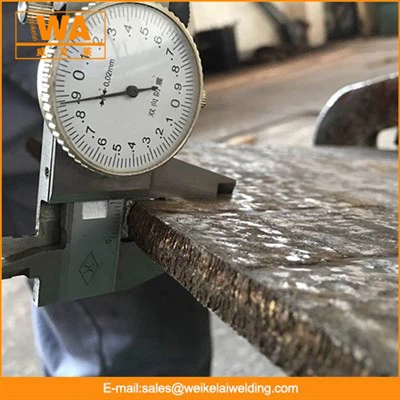
As a supplier of Overlay Wear Plates, I often get asked about the surface hardness distribution of these plates. It's a crucial factor, especially for industries that rely on wear-resistant materials to keep their operations running smoothly. In this blog, I'll share my insights on whether overlay wear plates have a good surface hardness distribution.
What Are Overlay Wear Plates?
Before diving into the surface hardness distribution, let's quickly go over what overlay wear plates are. Overlay wear plates are essentially composite materials made by welding a hardfacing alloy onto a base steel plate. This process creates a surface that's highly resistant to wear, abrasion, and impact. You can learn more about them here.


These plates are used in a wide range of industries, including mining, construction, agriculture, and manufacturing. They're commonly found in equipment like conveyor systems, crushers, buckets, and chutes, where they protect the underlying structure from the harsh effects of wear and tear.
The Importance of Surface Hardness Distribution
Surface hardness distribution refers to how evenly the hardness is spread across the surface of the overlay wear plate. A good surface hardness distribution is essential for several reasons.
First of all, it ensures uniform wear. If the hardness is not evenly distributed, some areas of the plate will wear out faster than others. This can lead to premature failure of the plate and costly downtime for the equipment. For example, in a mining conveyor system, uneven wear on the overlay wear plate can cause the conveyor belt to misalign, leading to material spillage and potential damage to the belt itself.
Secondly, a consistent surface hardness distribution improves the plate's resistance to impact. When a hard object strikes the plate, a well-distributed hardness helps to absorb and disperse the impact energy more effectively. This reduces the risk of cracking or chipping, which can compromise the plate's integrity and performance.
Factors Affecting Surface Hardness Distribution
Several factors can influence the surface hardness distribution of overlay wear plates.
One of the main factors is the welding process. The way the hardfacing alloy is welded onto the base plate can have a significant impact on the hardness distribution. If the welding parameters, such as the welding current, voltage, and travel speed, are not properly controlled, it can result in uneven heat input and inconsistent hardness. For instance, if the welding current is too high, it can cause overheating in some areas, leading to a decrease in hardness.
The composition of the hardfacing alloy also plays a role. Different alloys have different hardness properties, and the way they interact with the base plate can affect the surface hardness distribution. Some alloys may have a tendency to form hard spots or soft zones, depending on their chemical composition and the welding conditions.
The quality of the base plate is another important factor. A base plate with inconsistent thickness or surface defects can cause variations in the heat transfer during the welding process, which in turn can affect the hardness distribution of the overlay.
How to Ensure Good Surface Hardness Distribution
As a supplier, we take several steps to ensure that our overlay wear plates have a good surface hardness distribution.
We use advanced welding technologies and equipment to control the welding process precisely. Our welding operators are highly trained and experienced, and they follow strict quality control procedures to ensure that the welding parameters are within the specified range. This helps to minimize variations in heat input and ensure a consistent hardness across the surface of the plate.
We also carefully select the hardfacing alloys based on the specific application requirements. We work closely with our customers to understand their needs and recommend the most suitable alloy for their equipment. By choosing the right alloy, we can optimize the surface hardness distribution and improve the overall performance of the overlay wear plate.
In addition, we conduct thorough quality inspections on all our products. We use non-destructive testing methods, such as ultrasonic testing and magnetic particle testing, to detect any internal defects or inconsistencies in the hardness distribution. We also perform hardness testing at multiple points on the surface of the plate to ensure that the hardness meets the specified requirements.
Case Studies
To illustrate the importance of good surface hardness distribution, let's look at a couple of case studies.
A construction company was using overlay wear plates in their concrete mixer trucks. They had been experiencing premature wear and cracking on the plates, which was causing frequent breakdowns and costly repairs. After conducting an analysis, we found that the surface hardness distribution of the plates was uneven. Some areas had a much lower hardness than others, which was leading to accelerated wear and cracking.
We recommended that they switch to our overlay wear plates, which have a more consistent surface hardness distribution. After installing our plates, the construction company noticed a significant improvement in the performance of their mixer trucks. The plates lasted much longer, and there were fewer breakdowns, resulting in reduced maintenance costs and increased productivity.
Another example is a mining company that was using overlay wear plates in their ore crushers. They were facing problems with the plates wearing out quickly and causing excessive downtime. We analyzed their existing plates and found that the hardness distribution was not uniform, which was leading to uneven wear and premature failure.
We provided them with our high-quality overlay wear plates, which were specifically designed for the harsh conditions in the mining industry. Our plates had a better surface hardness distribution, which ensured uniform wear and improved resistance to impact. The mining company was very satisfied with the results. The plates lasted up to three times longer than their previous plates, and the downtime was significantly reduced, leading to increased production and profitability.
Conclusion
In conclusion, overlay wear plates can have a good surface hardness distribution if the right manufacturing processes and quality control measures are in place. A good surface hardness distribution is essential for ensuring uniform wear, improving impact resistance, and prolonging the lifespan of the plates.
As a supplier, we are committed to providing our customers with high-quality overlay wear plates that have a consistent surface hardness distribution. We use advanced technologies, carefully select the right alloys, and conduct thorough quality inspections to ensure that our products meet the highest standards.
If you're in the market for overlay wear plates or have any questions about surface hardness distribution, feel free to reach out to us. We'd be happy to discuss your specific requirements and help you find the best solution for your equipment. You can also learn more about our High Wear Resistant Steel and Hardfacing Protection Steel Plate products.
References
- "Welding Metallurgy and Weldability of Stainless Steels" by John C. Lippold and David J. Kotecki
- "Handbook of Hardfacing Alloys" by George E. Totten and David S. MacKenzie
- "Materials Science and Engineering: An Introduction" by William D. Callister Jr. and David G. Rethwisch