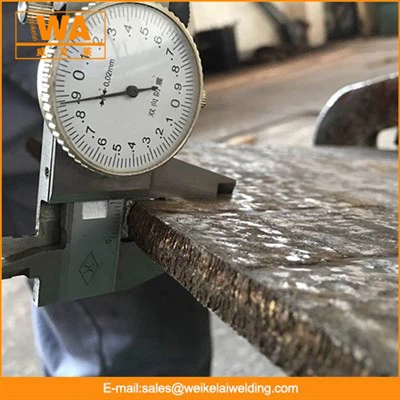
Hey there! I'm a supplier of Overlay Wear Plates, and today I wanna chat about the materials used to make these super - useful plates.
First off, let's talk about Chromium Carbide Overlay. It's one of the most popular materials for making overlay wear plates. Chromium carbide is known for its excellent hardness and wear resistance. When it's used as an overlay on a base plate, it can significantly enhance the plate's ability to withstand abrasion, erosion, and impact.


You know, in industries like mining, cement production, and power generation, where equipment is constantly exposed to harsh conditions, Chromium Carbide Overlay plates are a game - changer. They can protect the underlying base metal from getting worn out quickly. If you want to learn more about Chromium Carbide Overlay, you can check out Chromium Carbide Overlay.
The process of creating a Chromium Carbide Overlay on a wear plate usually involves welding. A mixture of chromium carbide particles and a binder material is welded onto the surface of the base plate. This forms a hard, wear - resistant layer that can last for a long time, even under heavy - duty use.
Another important material is Anti Wear Steel. Anti wear steel is specifically designed to resist wear and tear. It has a unique chemical composition and microstructure that gives it superior hardness and toughness. This type of steel is often used as the base material for overlay wear plates.
The advantage of using anti wear steel as a base is that it provides a strong foundation for the overlay. It can absorb the impact and stress without cracking or deforming easily. And when combined with a wear - resistant overlay, it creates a plate that can handle extremely tough conditions. For more details on Anti Wear Steel, you can visit Anti Wear Steel.
There are different grades of anti wear steel available, and the choice depends on the specific application. For example, in applications where there is high - impact abrasion, a higher - grade anti wear steel might be required. On the other hand, for less severe conditions, a lower - grade steel could be sufficient.
Wear Resistant Alloys are also commonly used in the production of overlay wear plates. These alloys are made by combining different metals to achieve specific properties. For instance, some wear - resistant alloys contain elements like nickel, molybdenum, and vanadium. These elements work together to improve the alloy's hardness, corrosion resistance, and wear resistance.
Wear Resistant Alloys can be used as either the overlay material or the base material, depending on the requirements. When used as an overlay, they can form a thin, but very hard layer on the surface of the plate. As a base material, they can provide additional strength and durability. To find out more about Wear Resistant Alloys, click on Wear Resistant Alloys.
The manufacturing process of overlay wear plates with wear - resistant alloys is quite precise. The alloy needs to be melted and then applied to the base plate in a controlled manner. This ensures that the overlay has a uniform thickness and quality.
Now, let's talk about how these materials interact with each other. When we combine Chromium Carbide Overlay with an anti wear steel base, we get a plate that has the best of both worlds. The hard chromium carbide overlay protects the surface from abrasion, while the tough anti wear steel base absorbs the impact.
Similarly, when a wear - resistant alloy is used in conjunction with other materials, it can enhance the overall performance of the overlay wear plate. For example, a wear - resistant alloy overlay on an anti wear steel base can provide better corrosion resistance in addition to wear resistance.
The choice of materials also depends on the cost - effectiveness. Sometimes, using a more expensive material might be justified if it significantly extends the lifespan of the overlay wear plate. On the other hand, for less critical applications, a more cost - efficient combination of materials might be preferred.
In terms of quality control, it's crucial to ensure that the materials used meet the required standards. We conduct various tests on the raw materials and the finished overlay wear plates. For example, hardness tests are done to check the hardness of the overlay and the base material. We also perform impact tests to make sure the plate can withstand the expected level of stress.
Another aspect to consider is the environmental impact of the materials. Some materials are more environmentally friendly than others. For instance, certain wear - resistant alloys might have a lower carbon footprint during production. As a responsible supplier, we always try to choose materials that are not only high - performing but also sustainable.
When it comes to customizing overlay wear plates, the choice of materials plays a key role. Different customers have different needs, and we can tailor the plates according to their specific requirements. For example, a customer in the food processing industry might need a wear - resistant plate that is also hygienic and corrosion - resistant. In such cases, we can select the appropriate materials and manufacturing processes to meet those needs.
In conclusion, the materials used to make overlay wear plates, such as Chromium Carbide Overlay, Anti Wear Steel, and Wear Resistant Alloys, are carefully chosen to provide the best performance in different applications. Whether it's for heavy - duty industrial use or more specialized applications, there's a combination of materials that can meet the requirements.
If you're in the market for overlay wear plates and want to discuss your specific needs, I'd love to have a chat. We can talk about the best materials for your application, the cost, and the delivery time. Don't hesitate to reach out and start a conversation about your overlay wear plate requirements.
References
- General knowledge on wear - resistant materials and overlay wear plate manufacturing processes from industry experience.
- Technical data sheets and research on Chromium Carbide Overlay, Anti Wear Steel, and Wear Resistant Alloys.