Fretting-corrosion is a complex phenomenon that combines the effects of mechanical wear and chemical corrosion, which often occurs in components under small-amplitude oscillatory motion, such as in joints, bearings, and couplings. Wear-resistant alloys are commonly used in such environments to enhance the service life of these components. As a leading supplier of wear-resistant alloys, I have witnessed firsthand the importance of understanding the wear resistance of these materials under fretting-corrosion conditions.
The Mechanism of Fretting - Corrosion
Fretting-corrosion involves a series of physical and chemical processes. Initially, the small-amplitude oscillatory motion between two contacting surfaces causes surface asperities to deform and break. This mechanical action exposes fresh metal surfaces, which are highly reactive. At the same time, the presence of corrosive media, such as oxygen and moisture in the environment, leads to the formation of oxide layers on these fresh surfaces. The oxide particles generated during the process can act as abrasives, further accelerating the wear of the surfaces.
The wear mechanisms in fretting-corrosion mainly include adhesive wear, abrasive wear, and oxidative wear. Adhesive wear occurs when the asperities of the two surfaces come into contact and adhere to each other, followed by the transfer of material between the surfaces. Abrasive wear is caused by the hard oxide particles or debris that abrade the surfaces. Oxidative wear results from the continuous formation and removal of oxide layers on the surfaces.
Wear Resistance of Different Wear - Resistant Alloys
Chromium Carbide - Based Alloys
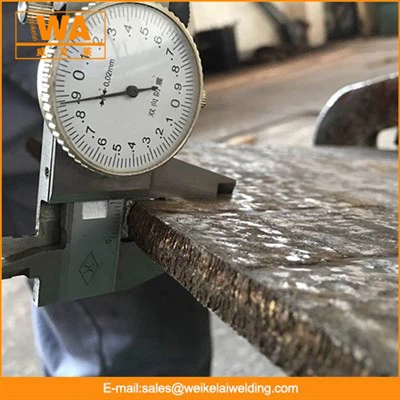
Chromium carbide-based alloys are widely used in applications requiring high wear resistance. Chromium Carbide Wear Plate and Chromium Carbide Plate are typical examples of such materials. Chromium carbide has a high hardness, which provides excellent resistance against abrasive wear. In fretting-corrosion conditions, the chromium carbide particles in the alloy matrix act as hard reinforcements, preventing the penetration of abrasive particles and reducing the material loss.
The chromium in the alloy also plays a crucial role in corrosion resistance. It forms a passive oxide layer on the surface, which acts as a barrier against the corrosive environment. However, under fretting conditions, the mechanical action can disrupt this passive layer, leading to local corrosion. Nevertheless, the high hardness of the chromium carbide phase helps to maintain the integrity of the surface to a certain extent and reduces the overall wear rate.
Bimetallic Wear - Resistant Materials
Bimetallic Wear Resistant Material combines two different metals or alloys to take advantage of their respective properties. One layer usually has high wear resistance, while the other layer provides good toughness or corrosion resistance. In fretting-corrosion conditions, the wear-resistant layer can effectively resist the mechanical wear, while the other layer can prevent the propagation of cracks and provide a stable substrate.
For example, a bimetallic material with a hard surface layer of a wear-resistant alloy and a tough backing layer of a steel alloy can offer excellent performance. The hard surface layer can withstand the abrasive and adhesive wear caused by fretting, while the tough backing layer can absorb the energy of the oscillatory motion and prevent the material from cracking.
Factors Affecting the Wear Resistance of Wear - Resistant Alloys in Fretting - Corrosion
Oscillation Amplitude
The amplitude of the small - amplitude oscillatory motion has a significant impact on the wear resistance of wear-resistant alloys in fretting-corrosion. A larger oscillation amplitude usually leads to more severe wear. As the amplitude increases, the relative motion between the two surfaces becomes more significant, resulting in greater deformation of the surface asperities and more intense adhesive and abrasive wear. Additionally, a larger amplitude can also disrupt the passive oxide layer more easily, accelerating the corrosion process.
Load
The load applied between the two contacting surfaces affects the wear rate. A higher load increases the contact pressure between the surfaces, which can lead to more severe plastic deformation of the surface asperities and enhance the adhesive wear. Moreover, the increased contact pressure can also promote the penetration of abrasive particles into the material, accelerating the abrasive wear. At the same time, the higher load may also cause the passive oxide layer to break down more quickly, increasing the susceptibility to corrosion.
Corrosive Environment
The nature of the corrosive environment, such as the presence of oxygen, moisture, and corrosive chemicals, has a profound influence on the fretting-corrosion behavior of wear-resistant alloys. Oxygen and moisture are essential for the formation of oxide layers on the surface. In a highly oxygenated and humid environment, the rate of oxide formation is faster, which can lead to more severe oxidative wear. Corrosive chemicals, such as acids or salts, can further accelerate the corrosion process by attacking the metal matrix or dissolving the oxide layers.
Testing and Evaluation of Wear Resistance in Fretting - Corrosion
To accurately assess the wear resistance of wear-resistant alloys in fretting-corrosion conditions, various testing methods are employed. One common method is the fretting wear test, which involves subjecting the test specimens to small-amplitude oscillatory motion under a controlled load and in a specific corrosive environment. The wear volume or mass loss of the specimens is measured after a certain number of cycles to evaluate the wear resistance.
In addition to the traditional wear tests, advanced characterization techniques, such as scanning electron microscopy (SEM), energy - dispersive X - ray spectroscopy (EDS), and X - ray diffraction (XRD), are used to analyze the wear mechanisms and the composition and structure of the worn surfaces. SEM can provide detailed information about the surface morphology, such as the presence of wear tracks, debris, and cracks. EDS can be used to determine the elemental composition of the worn surfaces, which helps to identify the corrosion products and the extent of material transfer. XRD can analyze the crystal structure of the materials and detect any phase changes during the fretting - corrosion process.
Applications of Wear - Resistant Alloys in Fretting - Corrosion Prone Environments
Wear-resistant alloys are widely used in many industries where fretting-corrosion is a significant concern. In the aerospace industry, components such as aircraft engine bearings and joints are often exposed to fretting-corrosion due to the vibration and small-amplitude motion during flight. The use of wear-resistant alloys can significantly improve the reliability and service life of these components.
In the automotive industry, engine components, such as piston rings and valve guides, are also prone to fretting-corrosion. Wear-resistant alloys can reduce the wear and corrosion of these components, improving the engine performance and fuel efficiency.


In the power generation industry, turbine blades and couplings are subjected to fretting-corrosion under the influence of vibration and high - temperature and high - pressure environments. The application of wear-resistant alloys can enhance the durability of these components and reduce the maintenance costs.
Conclusion
The wear resistance of wear-resistant alloys in fretting-corrosion conditions is a complex issue that is affected by multiple factors, including the alloy composition, oscillation amplitude, load, and corrosive environment. Understanding the wear mechanisms and the factors influencing wear resistance is crucial for the selection and application of wear-resistant alloys in fretting - corrosion prone environments.
As a wear-resistant alloys supplier, we are committed to providing high - quality materials that can effectively resist fretting - corrosion. Our Chromium Carbide Wear Plate, Chromium Carbide Plate, and Bimetallic Wear Resistant Material have been carefully developed and tested to ensure excellent performance in various fretting - corrosion conditions.
If you are looking for wear-resistant alloys for your specific applications, we invite you to contact us for more information and to discuss your procurement needs. Our team of experts is ready to provide you with professional advice and customized solutions.
References
- Hutchings, I. M. (1992). Tribology: friction and wear of engineering materials. CRC Press.
- ASTM G115 - 13(2019). Standard Guide for Conducting Fretting Wear Tests. ASTM International.
- Kato, K., & Adams, M. (Eds.). (2000). Fretting fatigue: current technology and practices. ASM International.