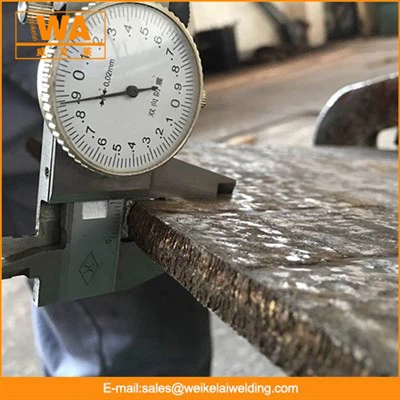
In the realm of industrial applications, the demand for materials that can withstand harsh conditions is ever - present. Among these, wear - resistant alloys play a crucial role, especially in alkaline environments. As a trusted wear - resistant alloys supplier, I have witnessed firsthand the significance of understanding the wear resistance of these alloys in such settings.
Alkaline Environments: A Challenge for Materials
Alkaline environments are characterized by a high pH level, typically above 7. These environments can be found in a variety of industries, including chemical processing, mining, and wastewater treatment. In these settings, materials are constantly exposed to alkaline solutions, which can cause corrosion and wear over time.
Corrosion in alkaline environments occurs through a series of chemical reactions. Hydroxide ions (OH⁻) present in alkaline solutions can react with the metal surface of the alloy, forming metal hydroxides. These hydroxides can either adhere to the surface, providing a certain degree of protection, or they can dissolve in the solution, leading to further corrosion. Additionally, the presence of other chemical species in the alkaline solution, such as salts and oxidizing agents, can accelerate the corrosion process.
Wear, on the other hand, is the progressive loss of material from the surface of the alloy due to mechanical action. In alkaline environments, wear can be exacerbated by the abrasive nature of the solution, as well as the chemical attack. For example, in mining operations, alkaline slurries containing abrasive particles can cause significant wear on the equipment used for extraction and processing.
Factors Affecting Wear Resistance in Alkaline Environments
Several factors influence the wear resistance of wear - resistant alloys in alkaline environments.
Alloy Composition
The composition of the alloy is one of the most important factors. Different elements have different effects on the alloy's performance in alkaline conditions. For instance, chromium is a common alloying element in wear - resistant alloys. Chromium forms a passive oxide layer on the surface of the alloy, which can protect it from corrosion in alkaline solutions. This layer acts as a barrier, preventing the hydroxide ions from reaching the metal surface.
Nickel is another element that can enhance the corrosion resistance of alloys in alkaline environments. Nickel - containing alloys are often more resistant to alkaline corrosion than alloys without nickel. It can also improve the toughness of the alloy, which is beneficial for wear resistance.
Molybdenum can increase the pitting and crevice corrosion resistance of alloys in alkaline solutions. It helps to maintain the integrity of the passive oxide layer, even in the presence of aggressive chemical species.
Microstructure
The microstructure of the alloy also plays a vital role. A fine - grained microstructure generally provides better wear resistance than a coarse - grained one. Fine grains can increase the strength and hardness of the alloy, making it more resistant to mechanical wear. Additionally, the distribution of phases in the alloy can affect its performance. For example, a homogeneous distribution of carbides in the alloy matrix can improve wear resistance by providing hard particles that can resist abrasion.
Surface Finish
The surface finish of the alloy can influence its wear resistance in alkaline environments. A smooth surface finish can reduce the adhesion of abrasive particles and the accumulation of corrosive products. It can also help to maintain the integrity of the passive oxide layer, as rough surfaces can provide sites for localized corrosion.
Types of Wear - Resistant Alloys and Their Performance in Alkaline Environments
Abrasion Resistant Steel
Abrasion Resistant Steel is widely used in applications where high wear resistance is required. In alkaline environments, its performance depends on its composition and microstructure. High - carbon abrasion - resistant steels can provide good wear resistance due to the presence of hard carbide particles. However, they may be more susceptible to corrosion in alkaline solutions compared to low - carbon steels. The addition of alloying elements such as chromium and nickel can improve the corrosion resistance of abrasion - resistant steels in alkaline environments.
Wear Resistant Stainless Steel
Wear Resistant Stainless Steel combines the properties of wear resistance and corrosion resistance. The high chromium content in stainless steel forms a passive oxide layer that protects the alloy from corrosion in alkaline solutions. Stainless steels with additional alloying elements like molybdenum and nickel can offer even better performance in alkaline environments. They are often used in applications where both wear and corrosion are concerns, such as in chemical processing equipment.
Chromium Carbide Wear Plate
Chromium Carbide Wear Plate is known for its excellent wear resistance. Chromium carbides are extremely hard and can provide high resistance to abrasion. In alkaline environments, the chromium in the carbide can also contribute to the formation of a passive oxide layer, which helps to protect the plate from corrosion. However, the performance of chromium carbide wear plates can be affected by the quality of the bonding between the carbide layer and the substrate, as well as the thickness of the carbide layer.
Testing and Evaluation of Wear Resistance in Alkaline Environments
To accurately assess the wear resistance of wear - resistant alloys in alkaline environments, various testing methods are employed.
Abrasion Testing
Abrasion testing involves subjecting the alloy sample to an abrasive medium in an alkaline solution. The amount of material lost after a certain period of testing is measured to evaluate the wear resistance. Different types of abrasion tests, such as pin - on - disk tests and slurry abrasion tests, can be used depending on the application.
Corrosion Testing
Corrosion testing is used to evaluate the alloy's resistance to chemical attack in alkaline solutions. Electrochemical methods, such as potentiodynamic polarization and electrochemical impedance spectroscopy, can be used to measure the corrosion rate of the alloy. Weight loss measurements can also be used to determine the amount of material lost due to corrosion over a specific period.


Microstructural Analysis
Microstructural analysis is essential for understanding the changes in the alloy's structure during exposure to alkaline environments. Techniques such as optical microscopy, scanning electron microscopy (SEM), and transmission electron microscopy (TEM) can be used to observe the microstructure and the distribution of phases in the alloy. Energy - dispersive X - ray spectroscopy (EDS) can be used to analyze the chemical composition of different regions in the alloy.
Applications of Wear - Resistant Alloys in Alkaline Environments
Wear - resistant alloys are used in a wide range of applications in alkaline environments.
Chemical Processing
In chemical processing plants, equipment such as pumps, valves, and pipelines are often exposed to alkaline solutions. Wear - resistant alloys are used to ensure the long - term reliability of these components. For example, wear - resistant stainless steel is commonly used in the construction of reactors and storage tanks for alkaline chemicals.
Mining
In the mining industry, alkaline slurries are used in various processes, such as ore extraction and beneficiation. Wear - resistant alloys are used in equipment such as crushers, conveyors, and slurry pumps. Abrasion - resistant steel and chromium carbide wear plates are commonly used to withstand the high levels of abrasion and corrosion in these applications.
Wastewater Treatment
Wastewater treatment plants often deal with alkaline wastewater. Wear - resistant alloys are used in equipment such as aerators, mixers, and sludge pumps. These alloys help to prevent corrosion and wear, ensuring the efficient operation of the treatment process.
Conclusion
Understanding the wear resistance of wear - resistant alloys in alkaline environments is crucial for selecting the right material for specific applications. The performance of these alloys depends on factors such as alloy composition, microstructure, and surface finish. Different types of wear - resistant alloys, such as Abrasion Resistant Steel, Wear Resistant Stainless Steel, and Chromium Carbide Wear Plate, offer different levels of wear and corrosion resistance in alkaline settings.
As a wear - resistant alloys supplier, I am committed to providing high - quality alloys that can meet the demanding requirements of various industries. If you are in need of wear - resistant alloys for applications in alkaline environments, I encourage you to contact me for a detailed discussion and procurement. Together, we can find the most suitable solution for your specific needs.
References
-ASM Handbook, Volume 13A: Corrosion: Fundamentals, Testing, and Protection. ASM International.
-Schutz, W. (2010). Wear and Corrosion of Metals in Aggressive Environments. Wiley - VCH.
-Barbucci, R., & Magagnini, P. (Eds.). (2012). Advanced Corrosion Science and Engineering. Springer.