Hey there! As a solid wire welding supplier, I often get asked about the penetration depth in solid wire welding. It's a super important topic, and I'm stoked to share what I know with you.
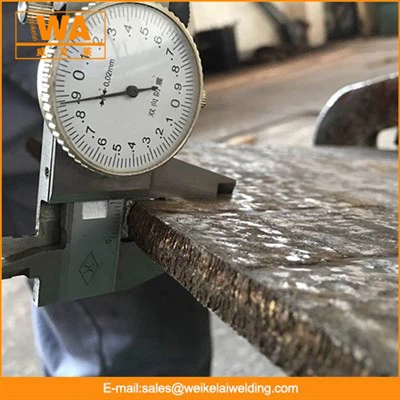
First off, let's talk about what penetration depth actually means. In solid wire welding, penetration depth refers to how deep the weld metal goes into the base metal. It's a key factor in determining the quality and strength of the weld. A good penetration depth ensures that the weld is properly fused with the base metal, creating a strong and durable joint.
So, what affects the penetration depth in solid wire welding? Well, there are a few key factors.
Welding Current
One of the most significant factors is the welding current. The higher the current, the deeper the penetration. This is because a higher current creates more heat, which melts more of the base metal and allows the weld metal to penetrate deeper. However, there's a catch. If the current is too high, it can lead to other problems like excessive spatter, burn-through, and poor weld bead appearance. So, it's all about finding the right balance.
Welding Voltage
Welding voltage also plays a role. Voltage affects the arc length and the shape of the weld pool. A higher voltage generally results in a wider and shallower weld bead, while a lower voltage gives a narrower and deeper penetration. But again, you can't just crank up or down the voltage without considering other factors. It needs to be adjusted in conjunction with the welding current to achieve the desired penetration depth and weld quality.
Travel Speed
The speed at which you move the welding torch, known as the travel speed, is another crucial factor. If you move too fast, the weld won't have enough time to penetrate the base metal properly, resulting in shallow penetration. On the other hand, if you move too slowly, you might end up with excessive heat input, which can cause burn-through and other issues. Finding the optimal travel speed is essential for getting the right penetration depth.
Wire Diameter
The diameter of the solid wire you're using can also impact penetration. Thicker wires typically require higher currents to melt, which can lead to deeper penetration. However, thicker wires may also be more difficult to control, especially in tight spaces or for thin materials. Thinner wires, on the other hand, are more flexible but may not provide as much penetration.
Base Metal Thickness and Type
The thickness and type of the base metal are important considerations too. Thicker base metals generally require more heat and deeper penetration to create a strong weld. Different types of metals also have different melting points and thermal conductivities, which can affect how the weld penetrates. For example, stainless steel has a higher thermal conductivity than mild steel, so it may require more heat input to achieve the same penetration depth.
Now, let's talk about why penetration depth matters. A proper penetration depth is crucial for several reasons.
Strength of the Weld
First and foremost, it affects the strength of the weld. A weld with insufficient penetration may not be able to withstand the loads and stresses it's designed for, leading to premature failure. On the other hand, a weld with excessive penetration can cause distortion and weaken the base metal around the weld area. So, getting the right penetration depth is essential for ensuring the structural integrity of the welded joint.
Weld Quality
Penetration depth also impacts the overall quality of the weld. A well-penetrated weld has a smooth and uniform appearance, with good fusion between the weld metal and the base metal. It's less likely to have defects like porosity, lack of fusion, or cracks, which can compromise the performance of the weld.
Applications
The required penetration depth can vary depending on the application. In some cases, such as in structural welding, a deep penetration is necessary to ensure the strength and stability of the structure. In other applications, like thin-sheet welding, a shallower penetration may be sufficient to avoid burn-through and maintain the integrity of the material.
As a solid wire welding supplier, I offer a wide range of products to meet different penetration depth requirements. For example, our Seamless Flux Cored Wire is great for achieving deep penetration in heavy-duty applications. It provides excellent weld quality and high deposition rates, making it a popular choice for many welders.
Our Mild Steel Mig Welding Wire is another versatile option. It's suitable for a variety of mild steel welding applications, with adjustable penetration depths depending on the welding parameters you choose.
And if you're looking for a wire for hardfacing applications, our Hardfacing Flux Cored Wire is designed to provide deep penetration and excellent wear resistance. It can help extend the lifespan of your equipment and reduce maintenance costs.
In conclusion, understanding the penetration depth in solid wire welding is essential for achieving high-quality welds. By considering factors like welding current, voltage, travel speed, wire diameter, and base metal properties, you can optimize the welding process to get the right penetration depth for your specific application.
If you're interested in learning more about our solid wire welding products or have any questions about penetration depth, feel free to reach out. We're here to help you find the best solutions for your welding needs. Let's start a conversation and see how we can work together to improve your welding operations.


References
- AWS Welding Handbook, Volume 1: Welding Science and Technology
- Welding Metallurgy and Weldability of Stainless Steels by John C. Lippold and David J. Kotecki
- Welding: Principles and Applications by Larry Jeffus