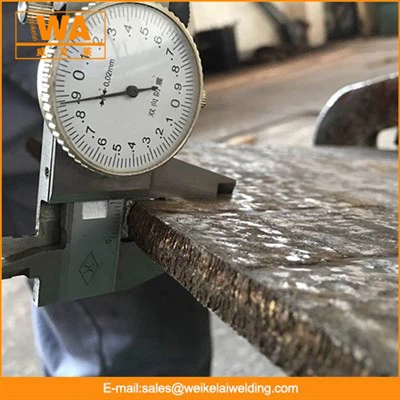
As a wear plate supplier deeply entrenched in the industry, I often encounter various technical inquiries from our clients. One question that frequently surfaces is about the modulus of elasticity of a wear plate. Understanding this concept is crucial for anyone involved in applications where wear plates are used, as it directly impacts the performance and durability of the plates in different scenarios.
Defining the Modulus of Elasticity
The modulus of elasticity, also known as Young's modulus, is a fundamental mechanical property that measures the stiffness of a material. In simple terms, it describes how much a material will deform under a given amount of stress within its elastic range. Mathematically, it is defined as the ratio of stress (force per unit area) to strain (deformation per unit length) in the linear elastic region of a material's stress - strain curve.
For wear plates, the modulus of elasticity provides valuable insights into how the plate will respond to external forces. A higher modulus of elasticity indicates that the material is stiffer and will deform less under stress. Conversely, a lower modulus of elasticity means the material is more flexible and will experience greater deformation for the same amount of stress.
Importance in Wear Plate Applications
In wear plate applications, the modulus of elasticity plays a vital role in several aspects. First, it affects the plate's ability to resist deformation under impact and abrasive forces. In industries such as mining, construction, and manufacturing, wear plates are often subjected to high - energy impacts and continuous abrasion. A wear plate with a high modulus of elasticity can better maintain its shape and integrity under these conditions, reducing the risk of premature failure and extending its service life.
Second, the modulus of elasticity is related to the plate's ability to distribute stress evenly. When a wear plate is loaded, the stress is distributed throughout the material. A material with a well - defined modulus of elasticity can distribute the stress more uniformly, preventing localized stress concentrations that can lead to cracking and other forms of damage.
Factors Affecting the Modulus of Elasticity of Wear Plates
Several factors can influence the modulus of elasticity of wear plates. One of the primary factors is the material composition. Different types of wear plates are made from various materials, such as [Wear Resistant Steel](/wear - plate/wear - resistant - steel.html), which typically has a relatively high modulus of elasticity due to its strong atomic bonds and crystalline structure.
The manufacturing process also has a significant impact. For example, [Hardfacing Processed Plate](/wear - plate/hardfacing - processed - plate.html) undergoes a specialized hardfacing process that can alter the material's microstructure and, consequently, its modulus of elasticity. Heat treatment, another common manufacturing step, can also modify the material's properties, including its stiffness.


The thickness of the wear plate can also affect its modulus of elasticity. In general, thicker plates tend to be stiffer and have a higher effective modulus of elasticity compared to thinner plates. However, this relationship is not always linear and can be influenced by other factors such as the plate's shape and the nature of the applied load.
Measuring the Modulus of Elasticity
There are several methods available for measuring the modulus of elasticity of wear plates. One of the most common methods is the tensile test. In a tensile test, a sample of the wear plate is subjected to a gradually increasing tensile force until it reaches its yield point or breaks. During the test, the stress and strain are measured, and the modulus of elasticity is calculated from the slope of the linear portion of the stress - strain curve.
Another method is the ultrasonic method. This non - destructive testing technique measures the velocity of ultrasonic waves traveling through the material. Since the velocity of ultrasonic waves is related to the material's elastic properties, the modulus of elasticity can be determined from the measured wave velocity.
Comparing Different Types of Wear Plates
When comparing different types of wear plates, the modulus of elasticity can be a useful parameter. For instance, [Cladding Steel Plate](/wear - plate/cladding - steel - plate.html) is a popular choice in many applications. It typically has a modulus of elasticity that is tailored to provide a balance between stiffness and toughness. The cladding layer, which is designed to resist wear, can have a different modulus of elasticity compared to the base steel, and this difference can be optimized to enhance the overall performance of the plate.
On the other hand, some advanced wear - resistant materials may have unique modulus of elasticity values that make them suitable for specific applications. For example, ceramic - reinforced wear plates may have a very high modulus of elasticity, which makes them extremely stiff and resistant to deformation. However, they may also be more brittle compared to metallic wear plates.
Practical Considerations in Selecting Wear Plates Based on Modulus of Elasticity
When selecting a wear plate for a particular application, it is essential to consider the modulus of elasticity in conjunction with other factors. For example, in applications where high - impact resistance is required, a wear plate with a moderate modulus of elasticity and high toughness may be more suitable. This allows the plate to absorb the impact energy without fracturing.
In contrast, in applications where dimensional stability is critical, such as in precision manufacturing processes, a wear plate with a high modulus of elasticity may be preferred. This ensures that the plate maintains its shape and dimensions under load, minimizing errors in the manufacturing process.
Real - World Examples
Let's take a look at some real - world examples to illustrate the importance of the modulus of elasticity in wear plate applications. In a mining operation, large - scale crushing equipment uses wear plates to protect the machinery from the abrasive action of rocks and minerals. The wear plates need to have a high modulus of elasticity to resist deformation under the high - pressure impact forces generated during the crushing process. A plate with a low modulus of elasticity would quickly deform and lose its effectiveness, leading to increased downtime and maintenance costs.
In the automotive industry, wear plates are used in engine components to reduce friction and wear. Here, the modulus of elasticity is important for ensuring proper alignment and smooth operation of the components. A wear plate with the right modulus of elasticity can help maintain the clearances between moving parts, improving the overall efficiency and reliability of the engine.
Conclusion
In conclusion, the modulus of elasticity is a critical property of wear plates that significantly influences their performance in various applications. As a wear plate supplier, we understand the importance of providing our customers with accurate information about this property to help them make informed decisions. Whether you are looking for [Cladding Steel Plate](/wear - plate/cladding - steel - plate.html), [Wear Resistant Steel](/wear - plate/wear - resistant - steel.html), or [Hardfacing Processed Plate](/wear - plate/hardfacing - processed - plate.html), understanding the modulus of elasticity can help you select the most suitable product for your specific needs.
If you are interested in learning more about wear plates or are looking to purchase high - quality wear plates for your application, we invite you to contact us for a detailed discussion. Our team of experts is ready to assist you in finding the perfect solution for your wear protection requirements.
References
- Callister, W. D., & Rethwisch, D. G. (2011). Materials Science and Engineering: An Introduction. Wiley.
- Ashby, M. F., & Jones, D. R. H. (2005). Engineering Materials 1: An Introduction to Properties, Applications and Design. Butterworth - Heinemann.
-ASM Handbook Committee. (1990). ASM Handbook Volume 1: Properties and Selection: Irons, Steels, and High - Performance Alloys. ASM International.