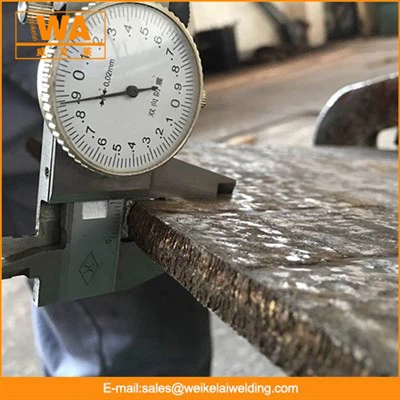
Hey there! As a wear plate supplier, I'm super excited to walk you through the manufacturing process of wear plates. Wear plates are essential in a ton of industries, from mining and construction to agriculture and manufacturing. They protect equipment from wear and tear, which can save companies a whole lot of money in the long run. So, let's dive right in!
Raw Material Selection
The first step in making wear plates is choosing the right raw materials. We've got a bunch of options, each with its own set of properties. For instance, Clad Wear Plate is a popular choice. It combines different materials to get the best of both worlds - high wear resistance and good toughness.
Another option is Wear Resistant Stainless Steel. This type of steel is great because it not only resists wear but also corrosion. It's perfect for applications where the wear plates will be exposed to harsh environments.
And then there's Bimetallic Wear Resistant Material. As the name suggests, it's made up of two different metals. This combination allows us to customize the properties of the wear plate according to the specific needs of the application.
When we're selecting the raw materials, we take into account a bunch of factors. The type of wear the plate will be exposed to, like abrasion, impact, or erosion, is a big one. We also consider the operating conditions, such as temperature, humidity, and the presence of chemicals.
Melting and Refining
Once we've got the right raw materials, it's time to melt them down. We use big furnaces for this. The temperature in these furnaces can get really high, sometimes over 1,500 degrees Celsius. The raw materials are loaded into the furnace, and as they heat up, they turn into a molten state.
During the melting process, we also do some refining. This is important because it helps us get rid of impurities in the metal. Impurities can weaken the wear plate and reduce its performance. We use different techniques for refining, like adding fluxes or using vacuum degassing.
Fluxes are substances that react with the impurities in the molten metal and form a slag on the surface. This slag can then be easily removed. Vacuum degassing, on the other hand, involves creating a vacuum in the furnace. This helps to remove dissolved gases, like hydrogen and oxygen, from the molten metal.
Casting
After the metal has been melted and refined, it's time for casting. Casting is the process of pouring the molten metal into a mold to give it the shape of the wear plate. We've got different casting methods, and the one we choose depends on the size, shape, and complexity of the wear plate.
One common casting method is sand casting. In sand casting, we make a mold out of sand. The sand is packed around a pattern that has the shape of the wear plate. The molten metal is then poured into the mold, and when it cools and solidifies, we get the wear plate. Sand casting is a relatively inexpensive method, and it's great for making large and simple-shaped wear plates.
Another method is investment casting. This method is more precise and can be used to make complex-shaped wear plates. In investment casting, we first make a wax pattern of the wear plate. The wax pattern is then coated with a ceramic shell. The wax is melted out, leaving a cavity in the ceramic shell. The molten metal is poured into this cavity, and after it solidifies, we break the ceramic shell to get the wear plate.
Heat Treatment
Once the wear plate has been cast, it goes through a heat treatment process. Heat treatment is really important because it helps to improve the mechanical properties of the wear plate, like hardness, toughness, and strength.
There are different types of heat treatment processes. One of the most common ones is quenching and tempering. In quenching, the wear plate is heated to a high temperature and then rapidly cooled by immersing it in a quenching medium, like oil or water. This makes the wear plate really hard. But quenching can also make the wear plate brittle. That's where tempering comes in.
Tempering involves heating the quenched wear plate to a lower temperature and then cooling it slowly. This helps to reduce the brittleness and improve the toughness of the wear plate.
Another heat treatment process is annealing. Annealing is used to soften the wear plate and relieve internal stresses. It involves heating the wear plate to a specific temperature and then cooling it slowly.


Machining and Finishing
After the heat treatment, the wear plate may need some machining. Machining is the process of removing excess material from the wear plate to get the desired dimensions and surface finish. We use different machining techniques, like turning, milling, and grinding.
Turning is used to make cylindrical shapes. In turning, the wear plate is rotated on a lathe, and a cutting tool is used to remove material from the surface. Milling, on the other hand, is used to make flat surfaces and complex shapes. In milling, a rotating cutter is used to remove material from the wear plate.
Grinding is a finishing process that is used to get a smooth surface finish. In grinding, an abrasive wheel is used to remove a very small amount of material from the surface of the wear plate.
Once the machining is done, the wear plate may also go through some finishing processes. This can include painting, coating, or polishing. Painting and coating can help to protect the wear plate from corrosion, while polishing can improve its appearance.
Quality Control
Throughout the manufacturing process, we have strict quality control measures in place. We want to make sure that every wear plate we produce meets the highest standards.
We use different testing methods to check the quality of the wear plates. Non-destructive testing methods, like ultrasonic testing and magnetic particle testing, are used to detect internal defects in the wear plates. These methods don't damage the wear plates, so they can still be used after the testing.
Destructive testing methods, like tensile testing and hardness testing, are also used. Tensile testing is used to measure the strength of the wear plate, while hardness testing is used to measure its hardness.
We also check the dimensions and surface finish of the wear plates to make sure they meet the specifications. Any wear plate that doesn't meet the quality standards is either reworked or scrapped.
Conclusion
So, there you have it - the manufacturing process of wear plates. It's a complex process that involves a lot of steps, but each step is crucial in ensuring that we produce high-quality wear plates.
If you're in the market for wear plates, whether it's Clad Wear Plate, Wear Resistant Stainless Steel, or Bimetallic Wear Resistant Material, we've got you covered. Our wear plates are made with the best raw materials and using the latest manufacturing techniques.
If you have any questions or if you're interested in placing an order, don't hesitate to reach out. We're always happy to help and have a chat about your specific needs.
References
- ASM Handbook Volume 6: Welding, Brazing, and Soldering
- Metals Handbook Desk Edition, Third Edition
- Manufacturing Engineering and Technology by S. Kalpakjian and S. R. Schmid