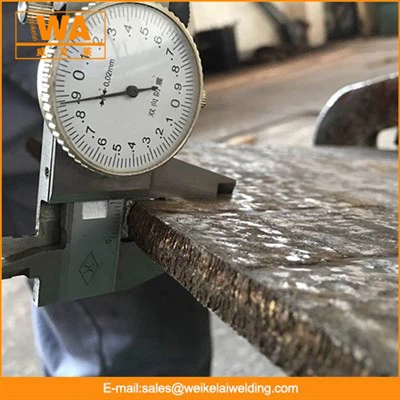
The elastic modulus, also known as Young's modulus, is a fundamental mechanical property that describes the stiffness of a material. In the context of Overlay Wear Plates, understanding the elastic modulus is crucial for both suppliers like us and our customers. It provides insights into how these plates will respond to applied forces, which is essential for their performance in various industrial applications.
What is the Elastic Modulus?
The elastic modulus is defined as the ratio of stress (force per unit area) to strain (deformation per unit length) within the elastic range of a material. Mathematically, it is expressed as:
[ E = \frac{\sigma}{\epsilon} ]
where ( E ) is the elastic modulus, ( \sigma ) is the stress, and ( \epsilon ) is the strain. This relationship holds true as long as the material remains in its elastic region, meaning that it will return to its original shape once the applied force is removed.
The elastic modulus is a measure of a material's resistance to elastic deformation. A high elastic modulus indicates a stiff material that requires a large force to produce a small amount of deformation, while a low elastic modulus means the material is more flexible and can deform more easily under a given force.
Elastic Modulus of Overlay Wear Plates
Overlay Wear Plates are composite materials typically consisting of a base metal and a wear-resistant overlay. The elastic modulus of these plates depends on several factors, including the composition of the base metal, the type of overlay material, and the manufacturing process.
The base metal of Overlay Wear Plates is usually a high-strength steel, which has a relatively high elastic modulus. For example, common structural steels have an elastic modulus in the range of 200 - 210 GPa (gigapascals). The overlay material, on the other hand, can vary widely depending on the specific application requirements. It may be a hardfacing alloy, ceramic, or other wear-resistant materials, each with its own unique elastic modulus.
In general, the elastic modulus of Overlay Wear Plates is a combination of the elastic moduli of the base metal and the overlay material. However, the exact value can be difficult to determine precisely due to the complex nature of the composite structure. Factors such as the bonding between the base metal and the overlay, the thickness of the overlay, and the distribution of the overlay material can all affect the overall elastic modulus of the plate.
Importance of Elastic Modulus in Overlay Wear Plates
The elastic modulus plays a significant role in the performance of Overlay Wear Plates in various industrial applications. Here are some key aspects:
Structural Integrity
In applications where Overlay Wear Plates are subjected to heavy loads or impact forces, a high elastic modulus is essential to maintain the structural integrity of the plates. A stiff plate with a high elastic modulus can resist deformation and prevent cracking or delamination of the overlay material, ensuring long-term durability and reliability.
Wear Resistance
The elastic modulus can also influence the wear resistance of Overlay Wear Plates. A plate with the appropriate elastic modulus can distribute the applied forces evenly across the surface, reducing the localized stress concentration that can lead to premature wear. Additionally, a high elastic modulus can help the plate maintain its shape and surface profile, which is important for minimizing friction and wear.
Compatibility with Equipment
When selecting Overlay Wear Plates for a specific application, it is important to consider the elastic modulus in relation to the equipment or structure in which they will be installed. The plates should have a compatible elastic modulus with the surrounding components to ensure proper fit and performance. Mismatched elastic moduli can lead to issues such as excessive stress transfer, vibration, and premature failure.
Measuring the Elastic Modulus of Overlay Wear Plates
There are several methods available for measuring the elastic modulus of materials, including Overlay Wear Plates. The most common method is the tensile test, which involves applying a gradually increasing tensile force to a specimen of the material and measuring the resulting deformation. The elastic modulus can then be calculated from the stress-strain curve obtained during the test.
Other methods for measuring the elastic modulus include the dynamic mechanical analysis (DMA), which measures the material's response to a dynamic load, and the ultrasonic method, which uses ultrasonic waves to determine the elastic properties of the material. These methods can provide more accurate and detailed information about the elastic modulus, especially for complex composite materials like Overlay Wear Plates.
Applications of Overlay Wear Plates
Overlay Wear Plates are widely used in various industries where wear resistance is a critical requirement. Some common applications include:


Mining and Quarrying
In the mining and quarrying industry, Overlay Wear Plates are used in equipment such as crushers, conveyors, and chutes to protect against abrasion and impact wear. The high elastic modulus of these plates ensures that they can withstand the heavy loads and harsh operating conditions encountered in these applications.
Construction
In the construction industry, Overlay Wear Plates are used in equipment such as bulldozers, excavators, and loaders to protect the blades, buckets, and other wear-prone components. The plates' ability to resist wear and maintain their shape under heavy loads is essential for the efficient operation of these machines.
Manufacturing
In the manufacturing industry, Overlay Wear Plates are used in a variety of applications, including metal forming, stamping, and machining. The plates can protect the dies, molds, and other tooling components from wear and damage, extending their service life and reducing production costs.
Conclusion
The elastic modulus is a critical mechanical property that plays a significant role in the performance of Overlay Wear Plates. Understanding the elastic modulus of these plates is essential for selecting the right material for a specific application, ensuring their structural integrity, wear resistance, and compatibility with equipment.
As a leading supplier of Overlay Wear Plates, we are committed to providing our customers with high-quality products that meet their specific requirements. Our team of experts can help you select the right Overlay Wear Plates based on your application needs, taking into account factors such as the elastic modulus, wear resistance, and cost.
If you are interested in learning more about our Overlay Wear Plates or have any questions about their elastic modulus or other properties, please feel free to [contact us for procurement and negotiation]. We look forward to working with you to find the best solutions for your wear protection needs.
References
- Callister, W. D., & Rethwisch, D. G. (2012). Materials Science and Engineering: An Introduction. Wiley.
- Ashby, M. F., & Jones, D. R. H. (2005). Engineering Materials 1: An Introduction to Properties, Applications, and Design. Butterworth-Heinemann.
- ASTM International. (2019). Standard Test Methods for Tension Testing of Metallic Materials. ASTM E8/E8M - 19a.