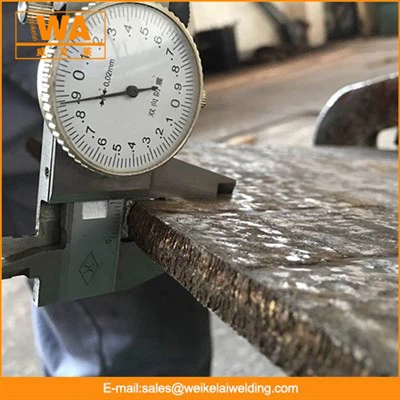
As a welding recondition supplier, I've witnessed firsthand the remarkable capabilities of welding reconditioning in restoring and enhancing the performance of various parts. However, like any industrial process, welding reconditioning has its limitations, especially when it comes to part size. In this blog post, I'll delve into the challenges and constraints associated with welding reconditioning large parts, and how these limitations can impact the feasibility and effectiveness of the process.
Thermal Distortion and Stress
One of the primary limitations of welding reconditioning in terms of part size is the potential for thermal distortion and stress. When welding large parts, the heat input from the welding process can cause significant temperature gradients within the part, leading to uneven expansion and contraction. This can result in distortion, warping, and residual stress, which can compromise the dimensional accuracy and mechanical properties of the part.
For example, when welding a large steel plate, the heat from the welding arc can cause the plate to expand locally, creating internal stresses that can lead to distortion. If the distortion is severe, it may be necessary to perform additional machining or straightening operations to restore the part to its original dimensions, which can add time and cost to the reconditioning process.
In addition to thermal distortion, welding large parts can also generate high levels of residual stress, which can reduce the fatigue life and structural integrity of the part. Residual stress can be particularly problematic in applications where the part is subjected to cyclic loading or dynamic stresses, as it can accelerate the initiation and propagation of cracks.
Accessibility and Weldability
Another challenge associated with welding reconditioning large parts is accessibility and weldability. Large parts often have complex geometries and internal structures, which can make it difficult to access all areas of the part for welding. This can limit the effectiveness of the reconditioning process and increase the risk of incomplete or defective welds.
For example, when welding a large industrial vessel, it may be necessary to access the interior of the vessel to perform repairs or modifications. However, the confined space and limited visibility inside the vessel can make it challenging to position the welding equipment and ensure proper weld penetration. In some cases, it may be necessary to use specialized welding techniques or equipment, such as remote welding systems or robotic welders, to overcome these challenges.
In addition to accessibility, the weldability of large parts can also be affected by factors such as material thickness, composition, and surface condition. Thick materials require more heat input to achieve proper fusion, which can increase the risk of thermal distortion and cracking. Similarly, materials with high carbon or alloy content may have poor weldability and require preheating or post-weld heat treatment to prevent cracking.
Equipment and Capacity
The size and weight of large parts can also pose challenges in terms of equipment and capacity. Welding reconditioning requires specialized equipment, such as welding machines, power sources, and handling equipment, which may have limitations in terms of the size and weight of the parts they can accommodate.
For example, a typical welding machine may have a maximum welding current and voltage rating, which can limit the thickness and type of materials that can be welded. Similarly, handling equipment, such as cranes and hoists, may have weight and capacity limitations, which can make it difficult to move and position large parts during the reconditioning process.
In addition to equipment limitations, the reconditioning facility itself may have physical constraints, such as limited floor space or height clearance, which can further restrict the size of the parts that can be processed. This can make it necessary to outsource the reconditioning of large parts to a specialized facility with the necessary equipment and capacity.
Cost and Time
Finally, the cost and time associated with welding reconditioning large parts can be significant. The reconditioning process for large parts typically requires more labor, materials, and equipment than smaller parts, which can increase the overall cost of the project. In addition, the complexity and challenges associated with welding large parts can also increase the time required to complete the reconditioning process, which can impact the production schedule and lead to downtime.
For example, a large-scale reconditioning project for a power generation turbine may require several weeks or even months to complete, depending on the extent of the damage and the complexity of the repairs. During this time, the turbine may be out of service, which can result in lost production and revenue for the customer.
Mitigating the Limitations
While the limitations of welding reconditioning in terms of part size can be significant, there are several strategies that can be employed to mitigate these challenges and improve the effectiveness of the reconditioning process.
One approach is to use advanced welding techniques and technologies, such as laser welding, electron beam welding, or friction stir welding, which can offer several advantages over traditional welding methods. These techniques typically generate less heat input, which can reduce the risk of thermal distortion and cracking, and can also provide better control over the welding process, resulting in higher quality welds.
Another strategy is to use preheating and post-weld heat treatment to reduce the risk of thermal distortion and residual stress. Preheating the part before welding can help to reduce the temperature gradient and minimize the risk of cracking, while post-weld heat treatment can help to relieve residual stress and improve the mechanical properties of the weld.
In addition to advanced welding techniques and heat treatment, proper planning and preparation are also essential for successful welding reconditioning of large parts. This includes conducting a thorough inspection of the part to identify the extent of the damage and develop a detailed reconditioning plan, as well as selecting the appropriate welding equipment and materials for the job.
Conclusion
In conclusion, welding reconditioning is a valuable process for restoring and enhancing the performance of various parts. However, when it comes to large parts, the process is subject to several limitations, including thermal distortion, accessibility, weldability, equipment and capacity, and cost and time. By understanding these limitations and implementing appropriate strategies to mitigate them, it is possible to overcome the challenges associated with welding reconditioning large parts and achieve successful results.
If you're considering welding reconditioning for your large parts, I encourage you to contact us to discuss your specific needs and requirements. Our team of experienced welding professionals has the expertise and equipment to handle even the most challenging reconditioning projects, and we're committed to providing high-quality services at competitive prices. Whether you need Welding Rebuild On Table Liner, Welding Recondition On Roller, or reconditioning for Coal Pulverizer Tables, we have the solutions you need.


References
- AWS Welding Handbook, American Welding Society
- Welding Metallurgy, John C. Lippold and David K. Miller
- ASME Boiler and Pressure Vessel Code, American Society of Mechanical Engineers