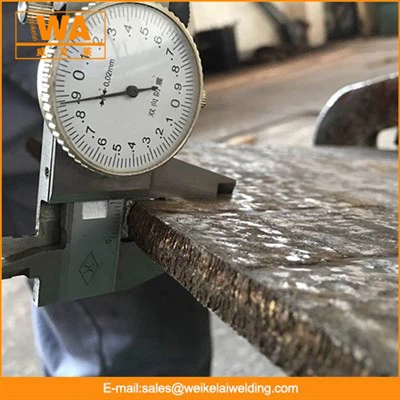
As a seasoned provider in the welding recondition industry, I've witnessed firsthand the distinct characteristics and implications of both manual and automated welding recondition processes. Understanding these differences is crucial for businesses and individuals seeking the most efficient and effective solutions for their welding recondition needs. In this blog, I'll delve into the key disparities between manual and automated welding recondition, shedding light on their respective advantages and limitations.
Precision and Consistency
One of the most significant differences between manual and automated welding recondition lies in the level of precision and consistency they offer. Manual welding recondition relies on the skill and expertise of the welder to control the welding process. While experienced welders can achieve high levels of precision, the quality of the weld can vary depending on factors such as the welder's fatigue, concentration, and technique. This variability can lead to inconsistencies in the final product, which may not meet the strict requirements of certain applications.
On the other hand, automated welding recondition uses computer-controlled systems to perform the welding process with a high degree of accuracy and repeatability. These systems are programmed to follow specific welding parameters, ensuring that each weld is consistent in terms of size, shape, and quality. This level of precision is particularly important in industries where tight tolerances and high-quality welds are essential, such as aerospace, automotive, and medical device manufacturing.
Speed and Efficiency
Another key difference between manual and automated welding recondition is the speed and efficiency of the processes. Manual welding recondition is a labor-intensive process that requires a skilled welder to perform each weld individually. This can be time-consuming, especially for large-scale projects or complex welds. Additionally, manual welding recondition may require multiple passes to achieve the desired weld quality, further increasing the time and cost of the project.
Automated welding recondition, on the other hand, can significantly reduce the time and cost of welding projects. By using robotic systems to perform the welding process, automated welding recondition can complete welds much faster than manual welding. These systems can also work continuously without breaks, reducing the overall production time. Additionally, automated welding recondition can be programmed to optimize the welding process, reducing the number of passes required and improving the overall efficiency of the project.
Skill Requirements and Training
Manual welding recondition requires a high level of skill and expertise from the welder. Welders must have a thorough understanding of welding techniques, materials, and safety procedures. They must also be able to read and interpret blueprints and welding symbols, as well as make adjustments to the welding process as needed. Training to become a skilled welder can take several years, and ongoing training is often required to keep up with the latest welding technologies and techniques.
Automated welding recondition, on the other hand, requires a different set of skills and expertise. While some basic welding knowledge is still necessary, the primary focus of training for automated welding recondition is on programming and operating the robotic systems. This includes learning how to use the programming software, setting up the welding parameters, and troubleshooting any issues that may arise. Training for automated welding recondition can be completed in a shorter period of time than training for manual welding recondition, and it can be more accessible to individuals with a background in programming or engineering.
Flexibility and Adaptability
Manual welding recondition offers a high degree of flexibility and adaptability. Welders can easily make adjustments to the welding process based on the specific requirements of the project. They can also work in a variety of environments and on different types of materials, making manual welding recondition a versatile solution for many applications.
Automated welding recondition, on the other hand, is less flexible and adaptable. Once the robotic system is programmed, it is designed to perform the welding process in a specific way. Making changes to the welding process can be time-consuming and may require reprogramming the system. Additionally, automated welding recondition is typically designed for high-volume production, and it may not be suitable for small-scale or custom projects.
Cost
The cost of manual and automated welding recondition can vary depending on several factors, including the size and complexity of the project, the type of materials being welded, and the location of the project. In general, manual welding recondition is more expensive than automated welding recondition for large-scale projects or high-volume production. This is because manual welding recondition requires more labor and time, which can increase the overall cost of the project.
Automated welding recondition, on the other hand, can be more cost-effective for large-scale projects or high-volume production. While the initial investment in the robotic system and programming software can be significant, the long-term cost savings can be substantial. Automated welding recondition can reduce labor costs, increase productivity, and improve the quality of the welds, resulting in a lower overall cost per unit.
Applications
Both manual and automated welding recondition have their own unique applications. Manual welding recondition is often used for small-scale projects, custom work, or projects that require a high degree of flexibility and adaptability. It is also commonly used in industries where the quality of the weld is critical, such as aerospace, automotive, and medical device manufacturing.
Automated welding recondition, on the other hand, is typically used for large-scale projects, high-volume production, or projects that require a high degree of precision and consistency. It is commonly used in industries such as automotive, aerospace, and manufacturing, where the demand for high-quality welds is high and the need for efficiency and productivity is paramount.
Conclusion
In conclusion, the differences between manual and automated welding recondition are significant and should be carefully considered when choosing a welding recondition solution. Manual welding recondition offers a high degree of flexibility and adaptability, but it can be time-consuming and expensive for large-scale projects. Automated welding recondition, on the other hand, offers a high degree of precision and consistency, as well as increased speed and efficiency, but it may not be suitable for small-scale or custom projects.


As a welding recondition provider, we understand the unique needs of our customers and can help them choose the most appropriate welding recondition solution for their project. Whether you need a manual welding recondition solution for a small-scale project or an automated welding recondition solution for a large-scale production run, we have the expertise and experience to deliver high-quality results.
If you're interested in learning more about our welding recondition services or would like to discuss your specific project requirements, please don't hesitate to contact us. We'd be happy to provide you with a free consultation and quote. You can also visit our website to learn more about our services, including Welding Rebuild On Roller, Repair Coal Mill Table Liners, and Roller Welding Repair.
References
- AWS Welding Handbook, Volume 1: Welding Science and Technology, American Welding Society
- Robotics in Welding, Assembly, and Manufacturing, John Wiley & Sons
- Welding Technology: Principles and Applications, Pearson Education