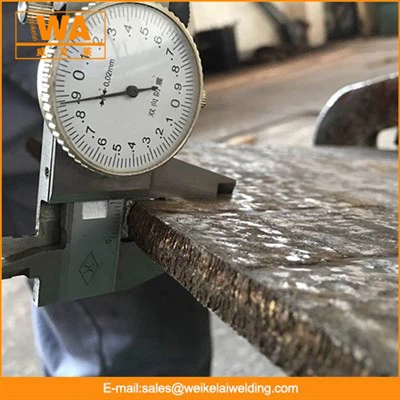
As a welding recondition supplier, I've had my fair share of experiences and challenges when it comes to the welding recondition of copper parts. Copper, with its excellent electrical and thermal conductivity, corrosion resistance, and malleability, is widely used in various industries such as electronics, automotive, and manufacturing. However, welding recondition of copper parts presents a unique set of difficulties that require careful consideration and expertise.
1. High Thermal Conductivity
One of the most significant challenges in welding recondition of copper parts is its high thermal conductivity. Copper conducts heat about three to four times faster than steel. This means that when we start welding, the heat spreads rapidly from the welding area. As a result, it becomes extremely difficult to maintain the required heat concentration at the weld joint.
To address this, we often need to use high - power welding equipment. For example, in some cases, we rely on high - energy welding processes like laser welding or electron beam welding. These processes can deliver a large amount of energy in a short period, enabling us to quickly heat the copper to the melting point before the heat dissipates. But these advanced welding methods also come with their own set of challenges, such as high equipment costs and the need for highly skilled operators.
Another approach is to pre - heat the copper parts. By pre - heating the workpiece, we can reduce the temperature gradient between the welding area and the surrounding material. This helps in minimizing the heat loss and makes it easier to achieve a proper weld. However, pre - heating requires careful control of the temperature. If the pre - heating temperature is too high, it can lead to grain growth in the copper, which will reduce the mechanical properties of the part.
2. Oxidation and Porosity
Copper has a strong affinity for oxygen at high temperatures. When copper is heated during the welding process, it readily reacts with oxygen in the air to form copper oxides. These oxides can cause several problems in the weld. Firstly, they can act as a barrier, preventing the proper fusion of the base metal and the filler metal. Secondly, the presence of oxides can lead to porosity in the weld. Porosity weakens the weld joint, reducing its strength and corrosion resistance.
To combat oxidation, we use shielding gases during the welding process. Argon is a commonly used shielding gas for copper welding. It creates an inert atmosphere around the weld area, preventing oxygen from coming into contact with the hot copper. In addition to shielding gases, we also use flux. Flux is a chemical compound that can react with the copper oxides and remove them from the weld area. It also helps in improving the wetting of the filler metal on the base metal.
However, using shielding gases and flux requires proper equipment and techniques. The flow rate of the shielding gas needs to be carefully adjusted. If the flow rate is too low, the shielding will be ineffective, and oxidation may still occur. If the flow rate is too high, it can cause turbulence, which may draw in air and also affect the quality of the weld.
3. Thermal Expansion and Contraction
Copper has a relatively high coefficient of thermal expansion. During the welding process, as the copper is heated, it expands. When it cools down after welding, it contracts. This thermal expansion and contraction can cause significant internal stresses in the weld joint and the surrounding material. These stresses can lead to cracking, distortion, and warping of the copper parts.
To deal with thermal expansion and contraction, we use proper welding techniques and fixturing. For example, we can use a sequence of intermittent welds instead of a continuous weld. This allows the part to cool down between welds, reducing the overall thermal stress. Fixturing can also be used to hold the parts in place during the welding process. By using fixtures, we can prevent the parts from moving due to thermal expansion and contraction, thus minimizing distortion.
4. Selection of Filler Metal
Choosing the right filler metal is crucial for successful copper welding recondition. The filler metal should have similar properties to the base metal in terms of composition, melting point, and thermal expansion coefficient. There are several types of filler metals available for copper welding, such as copper - based alloys, silver - based alloys, and nickel - based alloys.
Copper - based filler metals are often used when the goal is to maintain the high electrical and thermal conductivity of the copper parts. However, they may not have the same strength as some of the other filler metals. Silver - based filler metals offer good fluidity and can produce high - quality welds. But they are relatively expensive. Nickel - based filler metals are known for their high strength and good corrosion resistance. They can be a good choice for applications where the welded part will be exposed to harsh environments.
Selecting the appropriate filler metal requires a thorough understanding of the application requirements of the copper parts. We need to consider factors such as the mechanical properties, electrical conductivity, and corrosion resistance needed for the final product.
5. Surface Preparation
Proper surface preparation is essential for a successful welding recondition of copper parts. Copper surfaces often have contaminants such as oil, grease, dirt, and oxides. These contaminants can interfere with the welding process and lead to poor weld quality.
We start by cleaning the copper parts thoroughly. Solvents can be used to remove oil and grease. After that, mechanical cleaning methods such as sanding or wire brushing can be employed to remove the surface oxides. In some cases, chemical cleaning agents may also be used. However, it is important to ensure that the cleaning agents do not leave any residues on the surface, as these residues can also cause problems during welding.
Industry - Specific Applications and Challenges
In different industries, the challenges in welding recondition of copper parts can vary. For example, in the electronics industry, where copper is used for printed circuit boards and electrical connectors, the welding process needs to be very precise. The parts are often small and delicate, and any distortion or damage during welding can render the part useless.
In the automotive industry, copper parts such as radiators and heat exchangers require welds with high strength and good corrosion resistance. The welding process also needs to be efficient to meet the high - volume production requirements.
Our Solutions and Services
At our company, we have developed a range of solutions to overcome these challenges. We have state - of - the - art welding equipment that allows us to perform high - quality welding recondition on copper parts. Our team of experienced welders is trained to handle the unique requirements of copper welding.
We offer a variety of welding recondition services, including Roller Welding Repair, Welding Recondition On Roller, and Welding Rebuild On Table Liner. Whether you need to repair a damaged copper roller or rebuild a table liner, we have the expertise and the technology to get the job done.


Contact Us for Purchase and洽谈
If you are facing challenges with the welding recondition of your copper parts, or if you are looking for a reliable welding recondition supplier, we are here to help. Our team can provide you with customized solutions based on your specific requirements. We are committed to delivering high - quality welding recondition services at competitive prices. Contact us today to discuss your needs and start a successful partnership.
References
- AWS Welding Handbook, American Welding Society
- Welding Metallurgy of Copper and Copper Alloys, Research Publication
- Principles of Welding, Textbook on welding technology