Hey there! As a wear steel plate supplier, I often get asked about how to calculate the weight of wear steel plates. It's a crucial question, especially for those in industries like mining, construction, and manufacturing, where accurate weight calculations can impact everything from transportation costs to structural integrity. So, let's dive right in and break down the process step by step.
Understanding the Basics
First things first, to calculate the weight of a wear steel plate, you need to know a few key pieces of information: the dimensions of the plate (length, width, and thickness) and the density of the steel. The density of steel can vary depending on its composition, but a common value for carbon steel is around 7.85 grams per cubic centimeter (g/cm³).
Step 1: Measure the Dimensions
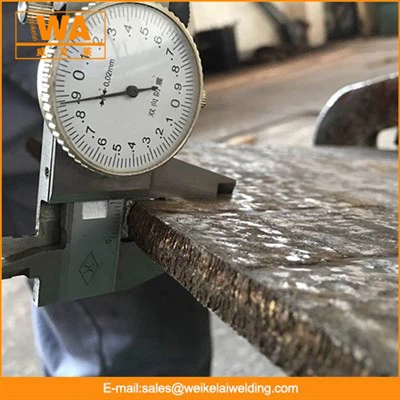
The first step is to measure the length, width, and thickness of the wear steel plate. Make sure to use the same unit of measurement for all three dimensions. For example, if you measure the length in meters, measure the width and thickness in meters as well. If you're dealing with a rectangular plate, measuring the dimensions is pretty straightforward. Just use a tape measure or a ruler to get the length and width, and a caliper to measure the thickness.
Step 2: Calculate the Volume
Once you have the dimensions, you can calculate the volume of the wear steel plate. The formula for the volume of a rectangular prism (which is what a steel plate is) is:
Volume = Length × Width × Thickness
Let's say you have a wear steel plate that is 2 meters long, 1 meter wide, and 0.01 meters thick. Using the formula, the volume would be:
Volume = 2 m × 1 m × 0.01 m = 0.02 cubic meters
Step 3: Determine the Density
As I mentioned earlier, the density of steel can vary depending on its composition. For most wear steel plates, a density of 7.85 g/cm³ is a good estimate. However, if you're dealing with a specific type of steel, you may need to look up its exact density. You can find this information in technical manuals or online resources.
Step 4: Calculate the Weight
Now that you have the volume and the density, you can calculate the weight of the wear steel plate. The formula for weight is:
Weight = Volume × Density
To use this formula, you need to make sure the units are consistent. Since the density is given in grams per cubic centimeter, you'll need to convert the volume from cubic meters to cubic centimeters. There are 1,000,000 cubic centimeters in a cubic meter, so you can multiply the volume in cubic meters by 1,000,000 to get the volume in cubic centimeters.
Continuing with our example, the volume in cubic centimeters would be:
Volume = 0.02 m³ × 1,000,000 cm³/m³ = 20,000 cm³


Now, you can calculate the weight using the density of 7.85 g/cm³:
Weight = 20,000 cm³ × 7.85 g/cm³ = 157,000 grams
To convert grams to kilograms, divide by 1000:
Weight = 157,000 g ÷ 1000 = 157 kilograms
Special Considerations
In some cases, you may need to account for additional factors when calculating the weight of a wear steel plate. For example, if the plate has holes or cutouts, you'll need to subtract the volume of the holes from the total volume before calculating the weight. To do this, measure the dimensions of the holes and calculate their volume using the same formula as for the plate. Then, subtract the volume of the holes from the total volume of the plate.
Another factor to consider is the shape of the plate. If the plate is not rectangular, you may need to use a different formula to calculate the volume. For example, if the plate is circular, you can use the formula for the volume of a cylinder:
Volume = π × (Radius²) × Thickness
where π is approximately 3.14159, the radius is half of the diameter of the circle, and the thickness is the same as before.
Importance of Accurate Weight Calculation
Accurate weight calculation is crucial for several reasons. First of all, it helps you determine the cost of the wear steel plate. Since steel is typically sold by weight, knowing the exact weight allows you to get an accurate quote from the supplier. It also helps with transportation planning. You need to know the weight of the plate to determine the appropriate shipping method and to ensure that the vehicle or equipment used for transportation can handle the load.
In addition, accurate weight calculation is important for structural design. If you're using wear steel plates in a construction project, the weight of the plates affects the overall stability and safety of the structure. Engineers need to know the exact weight of the plates to ensure that the structure can support the load.
Resources for Wear Steel Plates
If you're in the market for wear steel plates, there are several resources available to you. You can check out Abrasion Resistant Metals for more information about different types of abrasion-resistant metals. Hardfacing Wear Plate is another great resource that provides details about hardfacing wear plates. And if you're interested in wear-resistant alloys, Wear Resistant Alloys is a good place to start.
Conclusion
Calculating the weight of a wear steel plate is not as complicated as it may seem. By following the steps outlined in this blog post, you can easily calculate the weight of any wear steel plate. Remember to measure the dimensions accurately, determine the density of the steel, and account for any special factors. Accurate weight calculation is important for cost estimation, transportation planning, and structural design.
If you have any questions about wear steel plates or need help with weight calculation, feel free to reach out. We're here to assist you with all your wear steel plate needs. Whether you're looking for a specific type of wear steel plate or need advice on the best solution for your application, we've got you covered. Contact us today to start the procurement process and get the high-quality wear steel plates you need.
References
- Steel Handbook: Properties and Selection, Metals Park, Ohio: ASM International, 1990.
- Machinery's Handbook, Industrial Press Inc., 2012.