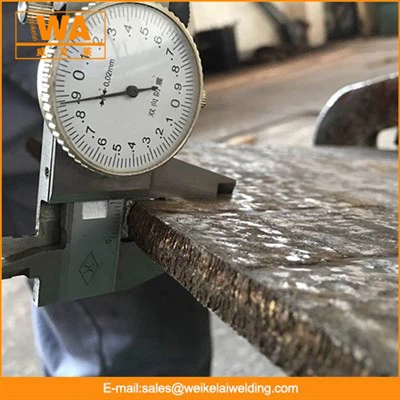
Flux Cored Arc welding (FCAW) is a popular welding process known for its high deposition rates, excellent penetration, and suitability for a wide range of applications. However, one common issue that welders often encounter is overlap, which can compromise the quality and integrity of the weld. In this blog post, as a Flux Cored Arc supplier, I'll share some practical tips on how to avoid overlap in Flux Cored Arc welding.
Understanding Overlap in Flux Cored Arc Welding
Overlap in FCAW occurs when the molten weld metal flows over the edge of the previous bead without proper fusion. This can result in a weak joint, reduced mechanical properties, and an increased risk of defects such as porosity and cracking. Overlap is often caused by factors such as incorrect welding parameters, improper torch angle, and poor bead placement.
Selecting the Right Welding Wire
The choice of welding wire plays a crucial role in preventing overlap. At our company, we offer a wide range of high - quality Stainless Flux Cored Welding Wire and Stainless Steel Mig Flux Cored Wire that are specifically designed for different applications and materials.
When selecting a welding wire, consider the following factors:


- Material Compatibility: Ensure that the wire is compatible with the base metal you are welding. Different metals require different wire compositions to achieve optimal fusion and avoid overlap.
- Diameter: The wire diameter affects the heat input and deposition rate. A smaller diameter wire may be more suitable for thin materials or when precise control is required, while a larger diameter wire can be used for thicker materials and higher deposition rates.
- Flux Type: The flux in the wire provides shielding gas, deoxidizers, and alloying elements. Choose a flux type that is appropriate for the welding position, material, and desired weld properties.
Optimizing Welding Parameters
Proper welding parameters are essential for preventing overlap. The main parameters to consider in FCAW are voltage, wire feed speed, and travel speed.
- Voltage: Voltage controls the arc length and the amount of heat input. A too - low voltage can result in a short arc, which may cause overlap as the weld metal has less time to spread and fuse properly. On the other hand, a too - high voltage can lead to excessive spatter and a wide, shallow bead. Adjust the voltage based on the wire diameter, material thickness, and welding position.
- Wire Feed Speed: The wire feed speed determines the amount of filler metal being deposited. A higher wire feed speed increases the deposition rate but also requires a higher voltage to maintain a stable arc. If the wire feed speed is too high relative to the voltage, the arc may become unstable, leading to overlap.
- Travel Speed: Travel speed refers to how fast the welding torch moves along the joint. A slow travel speed can cause the weld metal to pile up and overlap, while a fast travel speed may result in insufficient fusion. Find the right balance for your specific application to ensure proper bead formation.
Maintaining the Correct Torch Angle
The torch angle has a significant impact on the direction and shape of the weld bead. In FCAW, the torch should be held at an appropriate angle to ensure proper fusion and prevent overlap.
- Work Angle: The work angle is the angle between the axis of the welding torch and a line perpendicular to the joint. For most applications, a work angle of 5 - 15 degrees from vertical is recommended. This angle helps direct the molten weld metal into the joint and promotes good fusion.
- Travel Angle: The travel angle is the angle between the axis of the welding torch and the direction of travel. A drag angle (torch pointed backward) of 10 - 20 degrees is commonly used in FCAW. This angle helps to control the shape of the weld bead and prevent the molten metal from flowing ahead of the arc.
Proper Bead Placement
Proper bead placement is crucial for avoiding overlap. When making multiple passes, ensure that each bead is placed correctly relative to the previous one.
- Weaving Technique: If you are using a weaving technique, make sure that the width of the weave is consistent and that the torch moves smoothly across the joint. Over - weaving or uneven weaving can cause overlap at the edges of the bead.
- Interpass Cleaning: Before making each subsequent pass, clean the surface of the previous bead to remove any slag, spatter, or contaminants. This helps to ensure good fusion between the passes and reduces the risk of overlap.
Training and Practice
Even with the right equipment and parameters, avoiding overlap requires skill and experience. Providing training for welders is essential to ensure that they understand the proper techniques and can apply them consistently.
- On - the - Job Training: Offer on - the - job training opportunities for new welders to learn from experienced colleagues. This hands - on training allows them to practice welding techniques and gain confidence in their abilities.
- Continuous Improvement: Encourage welders to continuously improve their skills by participating in workshops, seminars, and certification programs. Staying updated with the latest welding technologies and techniques can help them avoid common issues such as overlap.
Quality Control and Inspection
Implementing a comprehensive quality control and inspection program is essential for ensuring that welds are free from overlap and other defects.
- Visual Inspection: Conduct visual inspections of the welds during and after the welding process. Look for signs of overlap, such as uneven bead surfaces or areas where the weld metal has flowed over the edge of the previous bead.
- Non - Destructive Testing (NDT): For critical applications, consider using non - destructive testing methods such as ultrasonic testing, radiographic testing, or magnetic particle testing to detect internal defects that may not be visible to the naked eye.
Conclusion
Avoiding overlap in Flux Cored Arc welding requires a combination of proper equipment selection, optimized welding parameters, correct torch angle, proper bead placement, training, and quality control. As a Flux Cored Arc supplier, we are committed to providing high - quality welding products and technical support to help you achieve excellent weld quality.
If you are interested in learning more about our Flux Cored Arc welding products or need assistance with your welding projects, we invite you to contact us for a detailed discussion. Our team of experts is ready to provide you with customized solutions based on your specific requirements. Let's work together to ensure the success of your welding operations.
References
- AWS Welding Handbook, American Welding Society
- Welding Technology: Principles and Applications, Larry Jeffus