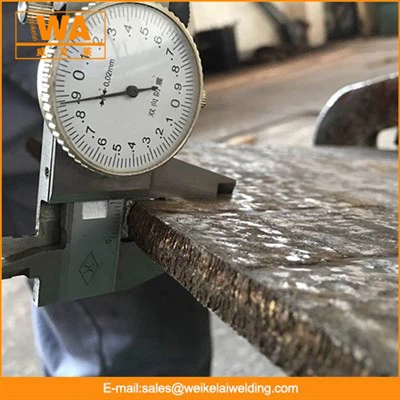
Can High Chrome Core Wire be welded?
As a supplier of High Chrome Core Wire, I often encounter questions from customers regarding the weldability of this product. High Chrome Core Wire is a specialized type of welding wire that offers unique properties and benefits, but understanding its weldability is crucial for achieving optimal results in various applications.
Understanding High Chrome Core Wire
High Chrome Core Wire, available at High Chrome Core Wire, is a type of flux-cored wire that contains a high percentage of chromium. Chromium is a key alloying element that imparts excellent corrosion resistance, high hardness, and good wear resistance to the weld deposit. These properties make High Chrome Core Wire suitable for a wide range of applications, including hardfacing, overlay welding, and repair of components exposed to severe wear, abrasion, and corrosion.
Weldability of High Chrome Core Wire
The weldability of High Chrome Core Wire depends on several factors, including the base metal, welding process, welding parameters, and post-weld heat treatment. In general, High Chrome Core Wire can be welded using common arc welding processes such as gas metal arc welding (GMAW), flux-cored arc welding (FCAW), and shielded metal arc welding (SMAW). However, some considerations need to be taken into account to ensure successful welding.
Base Metal Compatibility
The base metal plays a significant role in the weldability of High Chrome Core Wire. It is important to select a base metal that is compatible with the high chromium content of the wire. Generally, low-carbon steels, medium-carbon steels, and some alloy steels are suitable base metals for welding with High Chrome Core Wire. However, when welding to high-alloy steels or stainless steels, special attention should be paid to prevent the formation of brittle intermetallic compounds and to ensure good metallurgical bonding between the weld and the base metal.
Welding Process Selection
The choice of welding process depends on the specific application requirements, the thickness of the base metal, and the desired weld quality. Gas metal arc welding (GMAW) and flux-cored arc welding (FCAW) are commonly used processes for welding High Chrome Core Wire due to their high deposition rates and good weld quality. GMAW is suitable for thin to medium-thickness materials and provides a clean and precise weld. FCAW, on the other hand, is more suitable for thicker materials and offers better penetration and higher deposition rates. Shielded metal arc welding (SMAW) can also be used, but it is generally less efficient and requires more skill to achieve consistent results.
Welding Parameters
Proper welding parameters are essential for achieving good weld quality when using High Chrome Core Wire. The welding current, voltage, wire feed speed, and travel speed need to be adjusted according to the thickness of the base metal, the welding process, and the type of shielding gas (if applicable). Generally, higher welding currents and voltages are required for thicker materials to ensure sufficient penetration, while lower currents and voltages are used for thinner materials to prevent excessive heat input and distortion. The wire feed speed should be adjusted to maintain a stable arc and a consistent weld bead shape.
Post-Weld Heat Treatment
Post-weld heat treatment may be necessary to relieve residual stresses, improve the mechanical properties of the weld, and enhance the corrosion resistance of the weld deposit. The specific heat treatment requirements depend on the base metal, the welding process, and the application. In some cases, a simple stress-relieving heat treatment at a relatively low temperature may be sufficient. In other cases, a more complex heat treatment process, such as quenching and tempering, may be required to achieve the desired properties.
Applications of Welded High Chrome Core Wire
Welded High Chrome Core Wire finds applications in various industries where high wear resistance, corrosion resistance, and hardness are required. Some common applications include:
Hardfacing
Hardfacing is a process of depositing a layer of hard and wear-resistant material on the surface of a component to extend its service life. High Chrome Core Wire is widely used for hardfacing applications in industries such as mining, construction, agriculture, and manufacturing. It can be used to hardface components such as crusher jaws, conveyor belts, bucket teeth, and cutting edges, providing excellent resistance to abrasion, impact, and erosion.
Overlay Welding
Overlay welding is a technique used to repair or strengthen worn or damaged components by depositing a layer of weld metal on the surface. High Chrome Core Wire can be used for overlay welding of components made of low-carbon steels, medium-carbon steels, and some alloy steels. It can restore the original dimensions and properties of the component and improve its performance in harsh operating conditions.
Corrosion-Resistant Welding
The high chromium content of High Chrome Core Wire provides excellent corrosion resistance, making it suitable for welding applications in corrosive environments. It can be used to weld components in industries such as chemical processing, food processing, and marine engineering, where resistance to corrosion is critical.
Advantages of Using High Chrome Core Wire for Welding
There are several advantages of using High Chrome Core Wire for welding:
High Wear Resistance
The high chromium content in High Chrome Core Wire forms a hard and wear-resistant carbide phase in the weld deposit, providing excellent resistance to abrasion, impact, and erosion. This makes it ideal for applications where components are exposed to severe wear conditions.
Good Corrosion Resistance
The chromium in High Chrome Core Wire forms a passive oxide layer on the surface of the weld deposit, which protects the underlying metal from corrosion. This makes it suitable for welding applications in corrosive environments, such as chemical processing plants and marine structures.
High Hardness
High Chrome Core Wire can produce weld deposits with high hardness, which is beneficial for applications where high strength and resistance to deformation are required. The high hardness also helps to prevent the formation of cracks and improve the durability of the weld.
Easy to Weld
High Chrome Core Wire is relatively easy to weld using common arc welding processes. It has good arc stability, low spatter, and a smooth weld bead appearance, which makes it suitable for both experienced welders and beginners.
Conclusion
In conclusion, High Chrome Core Wire can be welded successfully using common arc welding processes, provided that the appropriate base metal, welding process, welding parameters, and post-weld heat treatment are selected. The high chromium content of High Chrome Core Wire provides excellent wear resistance, corrosion resistance, and hardness, making it suitable for a wide range of applications in various industries. As a supplier of High Chrome Core Wire, we are committed to providing high-quality products and technical support to our customers. If you have any questions or need further information about the weldability of High Chrome Core Wire or its applications, please feel free to contact us for procurement and negotiation.


References
- AWS Welding Handbook, Volume 1: Welding Science and Technology, American Welding Society
- ASM Handbook, Volume 6: Welding, Brazing, and Soldering, ASM International
- Welding Metallurgy and Weldability of Stainless Steels, John C. Lippold and David J. Kotecki