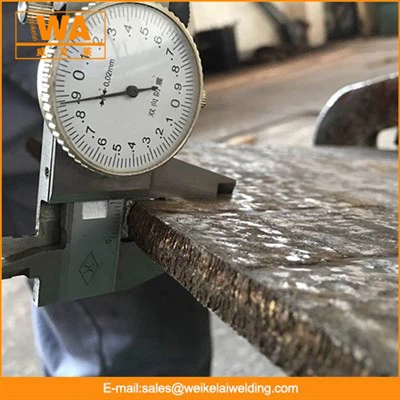
As a seasoned supplier of wear steel plates, I've witnessed firsthand the critical role these materials play in various industries. Wear steel plates are designed to withstand the harsh conditions of abrasion, impact, and corrosion, making them indispensable in sectors such as mining, construction, and manufacturing. To ensure the quality and performance of our products, we employ a range of testing methods. In this blog post, I'll delve into the key testing techniques used for wear steel plates and explain why they are so important.
Hardness Testing
Hardness is one of the most fundamental properties of wear steel plates. It refers to the material's resistance to indentation or scratching. A harder steel plate generally offers better wear resistance. We commonly use the Rockwell and Brinell hardness tests.
The Rockwell hardness test involves pressing a diamond cone or a hardened steel ball into the surface of the steel plate with a specific load. The depth of the indentation is then measured, and the hardness value is determined from a pre - calibrated scale. This test is quick and relatively non - destructive, making it suitable for routine quality control checks on our production line.
The Brinell hardness test, on the other hand, uses a hard steel or carbide ball to create an indentation under a large load. The diameter of the indentation is measured, and the Brinell hardness number is calculated. This test is more accurate for measuring the hardness of thick or large - grained materials. By conducting these hardness tests, we can ensure that our wear steel plates meet the required hardness standards for different applications.
Abrasion Testing
Abrasion is a major cause of wear in steel plates. To evaluate the abrasion resistance of our products, we use several types of abrasion tests. One of the most widely used methods is the pin - on - disc abrasion test. In this test, a pin made of a hard material is pressed against the surface of the wear steel plate, and the plate is rotated. The amount of material lost from the plate after a certain number of rotations is measured. This test simulates the sliding abrasion that occurs in many industrial processes, such as conveyor belts in mining operations.
Another important abrasion test is the rubber - wheel abrasion test. In this test, a sample of the wear steel plate is pressed against a rotating rubber wheel that is in contact with an abrasive material. The wear rate of the plate is determined by measuring the weight loss of the sample over a specific period. This test is particularly useful for evaluating the abrasion resistance of steel plates used in applications where they come into contact with loose abrasive particles, like in earth - moving equipment.
Impact Testing
In many industrial settings, wear steel plates are subjected to high - energy impacts. Impact testing is crucial to ensure that our plates can withstand these forces without cracking or breaking. The Charpy impact test is a standard method used to measure the impact toughness of steel. In this test, a notched sample of the wear steel plate is placed in a Charpy impact tester. A pendulum is released to strike the sample, and the energy absorbed by the sample during fracture is measured. A higher energy absorption indicates better impact toughness.
The Izod impact test is another similar test. It also measures the impact energy of a notched sample, but the sample is held in a different configuration compared to the Charpy test. By conducting these impact tests at different temperatures, we can assess the temperature - dependent impact properties of our wear steel plates. This is important for applications in cold environments, such as in the Arctic regions or high - altitude mining operations.
Chemical Composition Analysis
The chemical composition of a wear steel plate has a significant impact on its properties. We use advanced analytical techniques to determine the exact chemical composition of our plates. Spectroscopy methods, such as optical emission spectroscopy (OES) and X - ray fluorescence (XRF), are commonly used.
OES involves exciting the atoms in the steel sample with a high - energy spark or arc. The emitted light is then analyzed to identify the different elements present in the sample and their concentrations. XRF, on the other hand, uses X - rays to stimulate the atoms in the sample, and the characteristic X - rays emitted by the elements are detected and analyzed. By accurately determining the chemical composition, we can ensure that our wear steel plates have the right balance of elements for optimal performance. For example, the addition of elements like chromium can improve the corrosion and wear resistance of the steel, as seen in our Chromium Carbide Coating.
Microstructural Analysis
The microstructure of a wear steel plate affects its mechanical properties. We use metallographic techniques to examine the microstructure of our plates. First, a sample of the steel plate is prepared by cutting, grinding, and polishing it to a mirror - like finish. Then, it is etched with a suitable chemical solution to reveal the microstructure.
We use optical microscopes and electron microscopes to observe the microstructure at different magnifications. The size, shape, and distribution of grains, as well as the presence of any inclusions or phases, can be analyzed. For example, a fine - grained microstructure generally offers better strength and toughness compared to a coarse - grained one. By controlling the microstructure through proper heat treatment and alloying, we can enhance the performance of our wear steel plates.

Surface Roughness Testing
The surface roughness of a wear steel plate can also affect its wear performance. A smooth surface may reduce friction and wear in some applications, while in others, a certain level of surface roughness may be beneficial for improving the grip or adhesion. We use surface profilometers to measure the surface roughness of our plates.
A surface profilometer works by tracing a stylus over the surface of the plate and measuring the vertical displacement of the stylus as it moves. The data collected is then used to calculate various surface roughness parameters, such as Ra (average roughness) and Rz (maximum height of the profile). Our Smooth Wear Plate is an example of a product where surface roughness is carefully controlled to meet specific application requirements.
Corrosion Testing
In environments where wear steel plates are exposed to moisture, chemicals, or saltwater, corrosion can be a major concern. We conduct corrosion tests to evaluate the corrosion resistance of our plates. The salt spray test is a common method. In this test, the steel plate samples are placed in a chamber where they are exposed to a fine mist of saltwater. The samples are inspected regularly for signs of corrosion, such as rust formation.
Electrochemical corrosion tests are also used. These tests measure the corrosion rate of the steel plate by applying an electrical potential and measuring the resulting current. By understanding the corrosion behavior of our wear steel plates, we can recommend appropriate coatings or treatments to protect them. Our Wear Resistant Steel is designed to have good corrosion resistance, but additional protective measures may be necessary depending on the application environment.
In conclusion, the quality and performance of wear steel plates are ensured through a comprehensive range of testing methods. As a supplier, we are committed to using these advanced testing techniques to provide our customers with the highest - quality wear steel plates. Whether you are in the mining, construction, or manufacturing industry, choosing the right wear steel plate is crucial for the efficiency and longevity of your equipment. If you are interested in our wear steel plates or have any questions about our testing methods, please feel free to contact us for a detailed discussion and procurement negotiation.
References
- ASTM International. (20XX). Standard test methods for various properties of steel.
- ASM Handbook. (20XX). Volume on Wear and Erosion.
- Metallurgical textbooks on steel properties and testing.