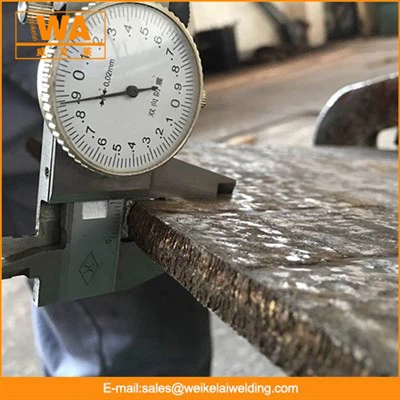
Slurry wear is a common and challenging form of wear in many industrial applications. It occurs when a solid - liquid mixture, known as slurry, flows across a material surface, causing abrasion and erosion. As a leading supplier of wear steel plates, understanding the slurry wear resistance of our products is crucial for providing the best solutions to our customers.
Understanding Slurry Wear
Slurry wear is a complex phenomenon influenced by multiple factors. The nature of the slurry itself plays a significant role. The size, shape, and hardness of the solid particles in the slurry are important variables. For example, larger and harder particles generally cause more severe wear. Angular particles can also be more abrasive than rounded ones because they can dig into the material surface more effectively.
The concentration of the solid particles in the liquid is another critical factor. Higher particle concentrations typically lead to increased wear rates as there are more particles available to interact with the surface. The type of liquid in the slurry also matters. Some liquids may be corrosive, which can exacerbate the wear process through a combination of corrosion and abrasion.
The flow conditions of the slurry are equally important. The velocity of the slurry flow affects the impact force of the particles on the surface. Higher flow velocities result in greater impact forces, increasing the wear rate. The flow pattern, whether laminar or turbulent, can also influence how the particles interact with the surface. Turbulent flow can cause the particles to move in more random directions, increasing the chances of them hitting the surface at different angles.
Factors Affecting the Slurry Wear Resistance of Wear Steel Plates
Chemical Composition
The chemical composition of a wear steel plate is fundamental to its slurry wear resistance. Elements such as carbon, chromium, nickel, and molybdenum play vital roles. Carbon is known to increase the hardness of the steel, which generally improves wear resistance. However, too much carbon can make the steel brittle, reducing its toughness and potentially leading to cracking under impact.
Chromium is an important alloying element as it forms hard carbides in the steel matrix. These carbides act as barriers to the abrasive particles in the slurry, increasing the wear resistance. Nickel is often added to improve the toughness of the steel, allowing it to withstand the impact of the particles without cracking. Molybdenum can enhance the hardenability of the steel and also contribute to the formation of hard phases, further improving wear resistance.
Microstructure
The microstructure of the wear steel plate also has a significant impact on its slurry wear resistance. A fine - grained microstructure generally provides better wear resistance compared to a coarse - grained one. Fine grains can resist the penetration of abrasive particles more effectively. Additionally, the presence of hard phases such as martensite or bainite in the microstructure can enhance wear resistance. These hard phases can withstand the abrasion caused by the slurry particles better than softer phases like ferrite.
Surface Hardness
Surface hardness is a key factor in determining the slurry wear resistance of a wear steel plate. A harder surface can resist the cutting and plowing action of the abrasive particles in the slurry. Heat treatment processes such as quenching and tempering can be used to increase the surface hardness of the steel plate. However, it is important to balance the surface hardness with the toughness of the material to prevent cracking under impact.
Testing the Slurry Wear Resistance of Wear Steel Plates
To accurately assess the slurry wear resistance of our wear steel plates, we use a variety of testing methods. One common method is the slurry pot test. In this test, a sample of the wear steel plate is immersed in a slurry - filled pot, and the pot is rotated to create a flow of the slurry across the sample surface. The weight loss of the sample after a certain period of time is measured, and this weight loss is used as an indicator of the wear resistance.
Another testing method is the jet erosion test. In this test, a high - velocity jet of slurry is directed at the sample surface. The erosion rate of the sample is measured by determining the volume or weight loss of the material over a specific time. These testing methods allow us to compare different wear steel plate materials and optimize our production processes to improve the slurry wear resistance of our products.


Our Wear Steel Plate Products for Slurry Wear Applications
As a wear steel plate supplier, we offer a range of products that are specifically designed to withstand slurry wear. Our Hardfacing Protection Steel Plate is a popular choice for applications where high - level wear protection is required. This plate is engineered with a hardfacing layer that provides excellent resistance to the abrasive action of the slurry particles.
Our Overlay Wear Plate is another product suitable for slurry wear applications. The overlay layer on this plate is composed of hard and wear - resistant materials, which can effectively protect the base steel from the erosive and abrasive effects of the slurry.
Our Wear Resistant Plate is also widely used in slurry - handling equipment. It is manufactured using advanced alloying and heat - treatment techniques to ensure high hardness and good toughness, providing reliable performance in slurry wear environments.
Conclusion
The slurry wear resistance of wear steel plates is a complex property that is influenced by many factors, including the chemical composition, microstructure, and surface hardness of the plate. At our company, we are committed to understanding these factors and using advanced testing methods to develop and produce wear steel plates with excellent slurry wear resistance.
If you are in need of wear steel plates for slurry wear applications, we invite you to contact us for more information and to discuss your specific requirements. Our team of experts is ready to provide you with the best solutions and high - quality products.
References
- ASTM G75 - 10(2015) Standard Test Method for Determination of Slurry Abrasion Resistance of Materials by the Miller Number.
- Hutchings, I. M. Tribology: Friction and Wear of Engineering Materials. CRC Press, 1992.
3.ASM Handbook, Volume 18: Friction, Lubrication, and Wear Technology. ASM International, 1992.