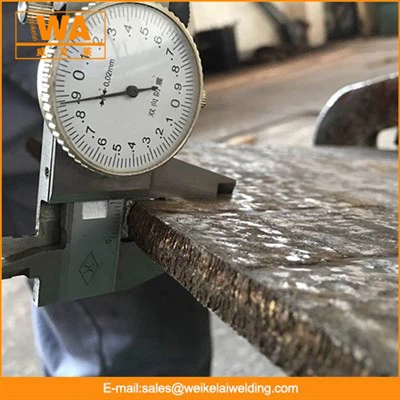
Hey there! I'm a supplier in the roller welding repair business. Over the years, I've seen my fair share of roller welding repair jobs go south. In this blog, I'm gonna dig into the reasons why roller welding repair might fail.


1. Poor Surface Preparation
One of the most common reasons for roller welding repair failure is poor surface preparation. Before you start welding, the surface of the roller needs to be clean and free from any contaminants like oil, grease, rust, or scale. If these contaminants are present, they can prevent the weld from properly bonding with the base metal.
For example, oil and grease can create a barrier between the welding electrode and the roller surface. When the weld pool forms, these contaminants can get trapped inside, leading to porosity in the weld. Porosity weakens the weld and makes it more prone to cracking.
Rust and scale are also big no - no's. They can introduce impurities into the weld, which can change the chemical composition of the weld metal and reduce its mechanical properties. To avoid this, we usually use methods like grinding, sandblasting, or chemical cleaning to prepare the surface. But if these steps are rushed or not done properly, the repair is likely to fail. You can learn more about the importance of proper surface preparation in Welding Rebuild On Roller.
2. Incorrect Welding Procedure
Choosing the right welding procedure is crucial for a successful roller welding repair. There are different welding processes available, such as shielded metal arc welding (SMAW), gas metal arc welding (GMAW), and submerged arc welding (SAW). Each process has its own advantages and disadvantages, and the choice depends on factors like the type of roller material, the size of the repair area, and the required quality of the weld.
If the wrong welding process is selected, it can lead to various problems. For instance, SMAW is a relatively simple and versatile process, but it may not be suitable for large - scale roller repairs because of its low deposition rate. On the other hand, GMAW offers a higher deposition rate, but it requires more precise control of the welding parameters.
In addition to the welding process, the welding parameters also play a vital role. Parameters like welding current, voltage, travel speed, and electrode or wire diameter need to be carefully adjusted. If the welding current is too high, it can cause excessive heat input, leading to distortion of the roller and cracking in the heat - affected zone. If the current is too low, the weld may not penetrate properly, resulting in a weak bond. You can find more details about welding procedures in Welding Recondition On Roller.
3. Material Mismatch
Using the wrong filler material is another major cause of roller welding repair failure. The filler material should be compatible with the base metal of the roller. Different roller materials have different chemical compositions and mechanical properties, and using an incompatible filler material can lead to problems.
For example, if you're welding a high - carbon steel roller with a low - carbon steel filler material, the weld may not have the same strength and hardness as the base metal. This can result in premature wear and failure of the repair. Also, a material mismatch can cause differences in thermal expansion coefficients between the weld metal and the base metal. During the cooling process after welding, these differences can generate internal stresses, which may lead to cracking.
We always make sure to analyze the chemical composition of the roller material before selecting the filler material. But sometimes, mistakes can happen, especially when dealing with complex or unknown roller materials. And this can have a significant impact on the success of the welding repair.
4. Heat - Affected Zone (HAZ) Issues
The heat - affected zone is the area of the base metal that is affected by the heat of welding but not melted. In roller welding repair, problems in the HAZ can cause failure. When the roller is heated during welding, the microstructure of the HAZ changes. Depending on the welding parameters and the base metal, this can lead to hardening, softening, or other undesirable changes in the material properties.
Hardening in the HAZ can make the area more brittle and prone to cracking. This is especially a concern when welding high - strength steels. On the other hand, softening in the HAZ can reduce the strength of the roller in that area, which can affect its performance under load. To minimize HAZ issues, we need to control the heat input during welding. This can be achieved by using proper welding parameters and pre - heating and post - heating techniques. But if these measures are not implemented correctly, the HAZ can become a weak point in the roller.
5. Residual Stresses
Welding generates residual stresses in the roller. These stresses are caused by the uneven heating and cooling during the welding process. Residual stresses can have a negative impact on the performance and durability of the roller. If the residual stresses are too high, they can cause distortion of the roller, which can affect its alignment and rotation.
Moreover, residual stresses can combine with external loads during the operation of the roller, increasing the likelihood of cracking. To relieve residual stresses, we often use methods like stress - relieving heat treatment. But if this step is skipped or not done properly, the residual stresses can remain in the roller and lead to long - term problems.
6. Inadequate Post - Weld Inspection
After the welding repair is completed, a thorough post - weld inspection is essential. This inspection helps to identify any defects in the weld, such as cracks, porosity, or lack of fusion. If these defects are not detected and corrected in time, they can grow over time and cause the repair to fail.
We usually use non - destructive testing methods like ultrasonic testing, magnetic particle testing, or dye penetrant testing to inspect the weld. But sometimes, the inspection may not be comprehensive enough, or the testing equipment may not be accurate. This can result in undetected defects, which can pose a risk to the integrity of the roller. You can learn about the importance of post - weld inspection in Welding Rebuild On Table Liner.
7. Operational Factors
Even if the welding repair is done perfectly, operational factors can still cause it to fail. For example, if the roller is subjected to excessive loads, high - speed rotation, or abrasive materials during its operation, it can put a lot of stress on the weld. This can cause premature wear or cracking of the weld.
Also, the environment in which the roller operates can have an impact. If the roller is exposed to corrosive substances, it can corrode the weld and the base metal, reducing the strength of the roller. In some cases, improper maintenance of the roller, such as lack of lubrication or misalignment, can also contribute to the failure of the welding repair.
In conclusion, there are many reasons why roller welding repair can fail. From poor surface preparation and incorrect welding procedures to material mismatch and operational factors, each aspect needs to be carefully considered and addressed. At our company, we've been working hard to minimize these risks and provide high - quality roller welding repair services.
If you're facing issues with roller welding repair or need reliable roller welding repair solutions, we're here to help. We have a team of experienced welders and technicians who can handle all kinds of roller welding repair jobs. Contact us to discuss your specific needs and let's work together to ensure the success of your roller welding repair projects.
References
- ASM Handbook, Volume 6: Welding, Brazing, and Soldering.
- Welding Metallurgy by John C. Lippold and David J. Kotecki.
- Standards and guidelines from the American Welding Society (AWS).