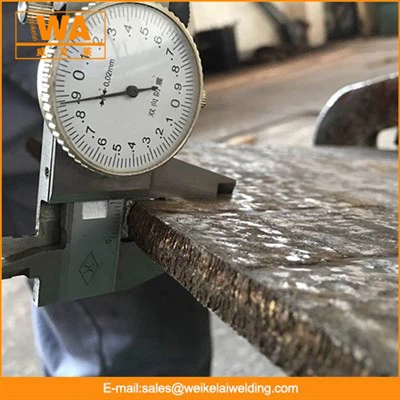
When it comes to the durability and longevity of pipes, hardfacing has emerged as a crucial technique. As a hardfacing pipe supplier, I've witnessed firsthand the transformative impact of different hardfacing methods on pipes. In this blog, I'll delve into the various hardfacing methods available for pipes, exploring their unique characteristics, advantages, and applications.
1. Shielded Metal Arc Welding (SMAW)
Shielded Metal Arc Welding, commonly known as stick welding, is one of the oldest and most widely used hardfacing methods. It involves using a consumable electrode coated with flux. When the electrode is struck against the pipe surface, an electric arc is formed, melting both the electrode and the base metal. The flux coating on the electrode decomposes, producing a shielding gas that protects the weld pool from atmospheric contamination.
One of the key advantages of SMAW is its simplicity and portability. It can be used in various environments, including outdoor and remote locations. SMAW is also suitable for hardfacing pipes with irregular shapes or in areas where access is limited. However, this method has some limitations. The deposition rate is relatively low compared to other methods, and the quality of the weld can be affected by the skill of the welder.
2. Gas Metal Arc Welding (GMAW)
Gas Metal Arc Welding, also known as MIG (Metal Inert Gas) welding, uses a continuous solid wire electrode and a shielding gas to protect the weld pool. The wire electrode is fed through a welding gun, and an electric arc is formed between the electrode and the pipe surface. The shielding gas, typically a mixture of argon and carbon dioxide, prevents oxidation and contamination of the weld.


GMAW offers several benefits for hardfacing pipes. It has a high deposition rate, which means that more filler metal can be added to the pipe surface in a shorter period. This results in faster hardfacing and increased productivity. The process is also relatively easy to learn and control, making it suitable for both experienced and novice welders. However, GMAW requires a shielding gas supply, which can be a limitation in some environments. Additionally, the equipment for GMAW is more complex and expensive than that for SMAW.
3. Flux-Cored Arc Welding (FCAW)
Flux-Cored Arc Welding is similar to GMAW, but instead of a solid wire electrode, it uses a tubular wire filled with flux. The flux in the wire provides the shielding gas and other additives that improve the quality of the weld. FCAW can be used with or without an external shielding gas, depending on the type of flux-cored wire used.
One of the main advantages of FCAW is its versatility. It can be used in various positions and is suitable for hardfacing pipes with different thicknesses. The flux in the wire also provides better protection against atmospheric contamination, resulting in higher-quality welds. FCAW has a higher deposition rate than SMAW and can be more productive than GMAW in some applications. However, the flux-cored wire can be more expensive than solid wire electrodes, and the process generates more fumes and spatter.
4. Submerged Arc Welding (SAW)
Submerged Arc Welding is a high-productivity hardfacing method that uses a granular flux to cover the weld area. The electrode wire is fed through a welding head, and an electric arc is formed beneath the flux layer. The flux protects the weld pool from atmospheric contamination and provides a slag that floats on the surface of the weld, protecting it as it cools.
SAW is known for its high deposition rate and excellent weld quality. It can be used for hardfacing large-diameter pipes and in high-volume production environments. The process is also relatively automated, which reduces the need for skilled labor. However, SAW requires a large amount of equipment and a dedicated workspace. It is also limited to flat or horizontal welding positions.
5. Plasma Transferred Arc Welding (PTAW)
Plasma Transferred Arc Welding is a precise and high-quality hardfacing method. It uses a plasma arc to melt the filler metal and the base metal. The plasma arc is created by passing a gas, usually argon, through a constricted nozzle. The filler metal is fed into the plasma arc, where it is melted and deposited on the pipe surface.
PTAW offers several advantages for hardfacing pipes. It provides a narrow and deep weld bead, which results in less distortion of the pipe. The process also has a high degree of control over the heat input, which is important for hardfacing pipes made of heat-sensitive materials. PTAW can produce high-quality hardfacing layers with excellent wear and corrosion resistance. However, the equipment for PTAW is expensive, and the process requires a high level of skill and expertise.
Applications of Hardfaced Pipes
Hardfaced pipes are used in a wide range of industries, including mining, oil and gas, power generation, and cement production. In the mining industry, Cco Abrasion Pipe are used to transport abrasive materials such as coal, ore, and sand. The hardfacing layer protects the pipe from wear and extends its service life. In the oil and gas industry, Wear Resistant Pipe are used in pipelines, wellheads, and valves to resist corrosion and erosion. In the power generation industry, hardfaced pipes are used in boilers, turbines, and other equipment to withstand high temperatures and pressures. In the cement production industry, Abrasion Resistant Elbows are used to transport cement and other abrasive materials.
Choosing the Right Hardfacing Method
When choosing a hardfacing method for pipes, several factors need to be considered. These include the type of pipe material, the application requirements, the production volume, and the budget. For example, if the pipe is made of a heat-sensitive material, a method with low heat input, such as PTAW, may be more suitable. If high productivity is required, a method with a high deposition rate, such as SAW or GMAW, may be a better choice.
As a hardfacing pipe supplier, I understand the importance of choosing the right hardfacing method for each application. I work closely with my customers to understand their needs and recommend the most appropriate hardfacing solution. Whether you need a small quantity of hardfaced pipes for a specific project or a large volume of pipes for continuous production, I can provide you with high-quality products and excellent service.
Contact for Procurement and Discussion
If you're interested in hardfaced pipes or have any questions about the different hardfacing methods, I'd be more than happy to assist you. Feel free to reach out to me to discuss your requirements and explore the best options for your application. I'm committed to providing you with the highest quality hardfacing pipes and the most cost-effective solutions.
References
- AWS Welding Handbook, American Welding Society
- Welding Metallurgy, John C. Lippold and David J. Kotecki
- Handbook of Hardfacing, ASM International