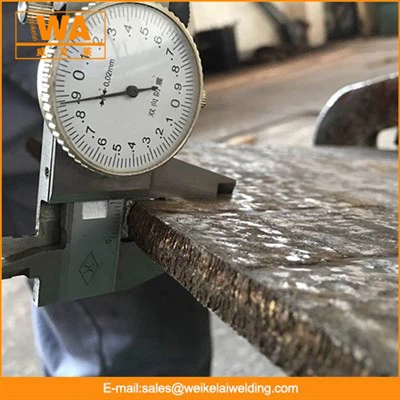
Roller welding repair is a crucial process in various industries, ensuring the longevity and efficiency of rollers used in machinery. As a leading Roller Welding Repair supplier, we have extensive experience with different roller welding repair techniques. In this blog, we will explore the differences between these techniques, their applications, advantages, and limitations.


1. Shielded Metal Arc Welding (SMAW)
Shielded Metal Arc Welding, also known as stick welding, is one of the oldest and most widely used welding processes. In SMAW, an electric current is used to create an arc between a flux - coated electrode and the roller surface. The flux coating on the electrode melts and forms a protective shield around the weld pool, preventing oxidation and contamination.
Advantages
- Portability: SMAW equipment is relatively simple and portable, making it suitable for on - site repairs. This is particularly useful when rollers cannot be easily transported to a workshop.
- Versatility: It can be used on a wide range of metals, including carbon steel, stainless steel, and cast iron. This makes it a versatile option for different types of rollers.
- Low equipment cost: The initial investment for SMAW equipment is relatively low compared to some other welding processes.
Limitations
- Low welding speed: SMAW is a relatively slow welding process, which can increase the repair time, especially for large - scale roller repairs.
- Quality variability: The quality of the weld can be highly dependent on the skill of the welder. Inconsistent welding techniques can lead to defects such as porosity, cracks, and lack of fusion.
- Limited penetration: The penetration depth of SMAW is relatively limited, which may not be sufficient for some heavy - duty roller applications.
2. Gas Metal Arc Welding (GMAW)
Gas Metal Arc Welding, commonly known as MIG (Metal Inert Gas) welding, uses a continuous solid wire electrode fed through a welding gun. A shielding gas, such as argon or a mixture of argon and carbon dioxide, is used to protect the weld pool from atmospheric contamination.
Advantages
- High welding speed: GMAW is a fast welding process, which can significantly reduce the repair time for rollers. This is especially beneficial for high - volume production or time - sensitive repair jobs.
- Good weld quality: GMAW produces high - quality welds with excellent fusion and low porosity. The process is relatively easy to control, resulting in consistent welds.
- Automation potential: GMAW can be easily automated, which is suitable for large - scale roller manufacturing and repair operations. Automated GMAW systems can improve productivity and reduce labor costs.
Limitations
- Equipment complexity: GMAW equipment is more complex than SMAW equipment, requiring a power source, wire feeder, shielding gas supply, and welding gun. This increases the initial investment and maintenance requirements.
- Limited outdoor use: The shielding gas used in GMAW can be easily affected by wind, making it less suitable for outdoor welding applications.
- Higher heat input: GMAW generally has a higher heat input compared to some other welding processes, which can cause distortion in thin - walled rollers.
3. Flux - Cored Arc Welding (FCAW)
Flux - Cored Arc Welding is similar to GMAW, but instead of a solid wire electrode, it uses a tubular wire filled with flux. The flux in the wire provides the shielding gas and slag protection for the weld pool.
Advantages
- High deposition rate: FCAW has a high deposition rate, which means it can deposit a large amount of weld metal in a short time. This makes it suitable for repairing rollers with large surface areas or significant material loss.
- Good penetration: FCAW can achieve good penetration, making it suitable for thick - walled rollers and heavy - duty applications.
- Versatility: It can be used in both indoor and outdoor environments, as the flux in the wire provides some protection against wind.
Limitations
- Slag removal: After welding, the slag formed on the weld surface needs to be removed, which adds an additional step to the repair process.
- Higher fume generation: FCAW generates more fumes compared to some other welding processes, which requires proper ventilation in the welding area.
- Weld appearance: The weld appearance of FCAW may not be as smooth as that of GMAW, which may be a concern for applications where aesthetics are important.
4. Submerged Arc Welding (SAW)
Submerged Arc Welding involves the formation of an arc between a continuously fed wire electrode and the roller surface. The arc is submerged under a layer of granular flux, which protects the weld pool from the atmosphere and provides additional alloying elements to the weld.
Advantages
- High welding speed and deposition rate: SAW is one of the fastest welding processes, with a very high deposition rate. This makes it ideal for large - scale roller repairs and new roller manufacturing.
- Deep penetration: SAW can achieve deep penetration, which is suitable for thick - walled rollers and heavy - duty applications.
- Good weld quality: The submerged arc process results in high - quality welds with low porosity and excellent mechanical properties.
Limitations
- Limited accessibility: SAW is not suitable for welding in tight spaces or complex geometries, as the flux and electrode need to be properly positioned.
- Equipment complexity: SAW equipment is relatively complex and requires a power source, wire feeder, flux hopper, and control system. This increases the initial investment and maintenance requirements.
- Flux handling: The flux used in SAW needs to be properly stored, recycled, and disposed of, which adds to the operational complexity.
Applications of Different Roller Welding Repair Techniques
The choice of roller welding repair technique depends on several factors, including the type of roller, the extent of damage, the material of the roller, and the application requirements.
- Light - duty rollers: For light - duty rollers with minor surface damage, SMAW or GMAW may be sufficient. These processes are relatively easy to perform and can provide adequate repair quality at a reasonable cost.
- Heavy - duty rollers: Heavy - duty rollers used in industries such as mining and steel manufacturing often require high - strength and high - quality welds. FCAW and SAW are more suitable for these applications due to their high deposition rate and deep penetration.
If you are looking for Repair Coal Mill Table Liners, our experts can recommend the most appropriate welding repair technique based on the specific requirements of your coal mill table liners. Similarly, for Welding Recondition On Roller and Welding Rebuild On Roller, we have the expertise and experience to ensure a high - quality repair.
Conclusion
As a Roller Welding Repair supplier, we understand the importance of choosing the right welding repair technique for different rollers. Each technique has its own advantages and limitations, and the selection should be based on a comprehensive consideration of various factors. Whether you need a fast - paced repair for a high - volume production line or a high - quality weld for a heavy - duty roller, we can provide the most suitable solution.
If you are interested in our roller welding repair services or have any questions about the different welding techniques, please feel free to contact us for a consultation. We are committed to providing you with the best - in - class roller welding repair solutions to meet your specific needs.
References
- AWS Welding Handbook, American Welding Society
- Welding Metallurgy, John C. Lippold and David K. Matlock
- Industrial Welding Technology, George E. Totten and D. Scott MacKenzie