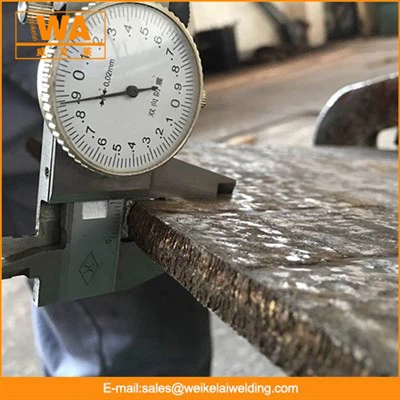
As a long - time supplier of wear resistant alloys, I've witnessed firsthand the numerous challenges that come with producing these high - quality materials. Wear resistant alloys are crucial in a wide range of industries, from mining and construction to manufacturing and transportation. They are used to create components that can withstand the harsh conditions of abrasion, impact, and corrosion, which significantly extends the lifespan of equipment and reduces maintenance costs. However, achieving the desired quality and performance of wear resistant alloys is no easy feat.
1. Material Selection
One of the primary challenges in producing high - quality wear resistant alloys is selecting the right materials. The composition of an alloy has a direct impact on its wear resistance, hardness, toughness, and other mechanical properties. Different applications require different alloy compositions. For example, in mining applications where there is severe abrasion, alloys with high levels of chromium and carbide are often preferred. Chromium forms hard carbides that can resist the cutting and plowing action of abrasive particles.
However, sourcing high - purity raw materials can be a challenge. The quality of raw materials can vary significantly from one supplier to another. Impurities in the raw materials can have a detrimental effect on the properties of the final alloy. For instance, sulfur and phosphorus impurities can reduce the toughness and weldability of the alloy. Ensuring a consistent supply of high - quality raw materials is essential for producing wear resistant alloys with reliable performance.
2. Melting and Casting Processes
The melting and casting processes are critical steps in the production of wear resistant alloys. During melting, it is necessary to achieve a homogeneous mixture of the different alloying elements. This requires precise control of the melting temperature and time. If the melting temperature is too low, the alloying elements may not dissolve completely, resulting in an inhomogeneous structure. On the other hand, if the temperature is too high, there may be excessive evaporation of some elements, leading to a change in the alloy composition.
Casting is also a complex process. The molten alloy must be poured into molds with the right shape and size. The cooling rate during casting is crucial. A rapid cooling rate can result in a fine - grained structure, which generally improves the wear resistance and mechanical properties of the alloy. However, rapid cooling can also cause internal stresses and cracking in the casting. Controlling the cooling rate requires careful design of the casting mold and the use of appropriate cooling methods.
3. Heat Treatment
Heat treatment is another significant challenge in the production of wear resistant alloys. Heat treatment processes such as quenching, tempering, and annealing are used to modify the microstructure of the alloy and improve its mechanical properties. For example, quenching can increase the hardness of the alloy by transforming the austenite phase into martensite. However, quenching can also cause distortion and cracking of the alloy due to the large thermal stresses generated during the rapid cooling process.
Tempering is often carried out after quenching to relieve these stresses and improve the toughness of the alloy. Determining the optimal heat treatment parameters, such as temperature and time, is a complex task. It requires a deep understanding of the alloy's composition and microstructure. Different alloy compositions respond differently to heat treatment, and even small variations in the heat treatment process can have a significant impact on the final properties of the alloy.
4. Quality Control
Maintaining strict quality control throughout the production process is essential for producing high - quality wear resistant alloys. Quality control involves a series of inspections and tests at different stages of production. Non - destructive testing methods, such as ultrasonic testing and magnetic particle testing, are used to detect internal defects in the castings or forged parts. Destructive testing methods, such as hardness testing, tensile testing, and wear testing, are used to evaluate the mechanical properties and wear resistance of the alloy.
However, conducting these tests accurately and consistently can be challenging. The testing equipment needs to be calibrated regularly to ensure accurate results. In addition, the testing environment can also affect the test results. For example, the temperature and humidity can influence the wear testing results. Ensuring that all products meet the required quality standards is a continuous challenge, especially when producing large - volume orders.
5. Meeting Diverse Customer Requirements
Customers in different industries have diverse requirements for wear resistant alloys. Some customers may require alloys with high hardness and wear resistance for applications in highly abrasive environments, such as in the mining of hard ores. Others may need alloys with good toughness and impact resistance for applications where there is significant impact loading, such as in construction equipment.
Meeting these diverse requirements often means developing custom - made alloys. This requires significant research and development efforts. Our company needs to work closely with customers to understand their specific needs and then design and produce alloys that meet those requirements. Developing new alloy compositions and production processes can be time - consuming and costly.
6. Environmental and Regulatory Compliance
In recent years, environmental and regulatory compliance has become an increasingly important challenge in the production of wear resistant alloys. The production processes of alloys often involve the use of large amounts of energy and the generation of waste materials. For example, melting and casting processes consume a significant amount of electricity, and the disposal of waste materials, such as slag and scrap metal, needs to comply with environmental regulations.


In addition, some alloying elements, such as lead and mercury, are considered hazardous substances. The use and disposal of these elements need to be strictly regulated. Ensuring compliance with environmental and regulatory requirements not only requires investment in environmental protection equipment but also continuous improvement of production processes to reduce the environmental impact.
Our Solutions and Offerings
Despite these challenges, our company has been committed to producing high - quality wear resistant alloys. We have established a strict quality control system to ensure the consistency and reliability of our products. Our experienced R & D team is constantly working on developing new alloy compositions and production processes to meet the diverse needs of our customers.
We offer a wide range of wear resistant products, including Bimetal Wear Plate, Wear Resistant Plate, and Composite Wear Plates. These products are widely used in various industries and have received positive feedback from our customers.
If you are interested in our wear resistant alloys or have specific requirements for your applications, we welcome you to contact us for procurement and negotiation. We are confident that our high - quality products and professional services will meet your needs and help you improve the performance and lifespan of your equipment.
References
- Smith, J. R., & Johnson, M. K. (2018). Wear Resistant Materials: Fundamentals, Selection, and Applications. CRC Press.
- Davis, J. R. (2008). Handbook of Hardfacing Alloys. ASM International.
- Li, X., & Zhang, Y. (2015). Advances in Wear Resistant Materials. Elsevier.